
FNIRSI DSO152
4.4Editor score
200kHz bandwidth real-time sampling
Pocket sized portable design
Built-in rechargeable battery
Finding a reliable oscilloscope without breaking the bank is a common challenge for hobbyists and professionals alike. Affordable models have evolved significantly, offering features once reserved for expensive benchtop units. These devices enable precise signal analysis for electronics projects, automotive diagnostics, and educational purposes.
To create this list, we evaluated ten top-rated budget oscilloscopes based on their bandwidth, sampling rate, display quality, and additional functionalities like signal generation. We considered user feedback, technical specifications, and real-world applicability to ensure each recommendation meets high standards for performance and durability in various environments.
Each pick in this guide highlights specific strengths and ideal use cases, helping you match a device to your particular requirements. While prices may fluctuate due to market dynamics and promotions, the value propositions remain consistent. Always verify the latest details before purchasing to ensure you get the best deal available today.
4.4Editor score

4.3Editor score

4.1Editor score
As an Amazon Associate we earn from qualifying purchases.
The following table provides a side-by-side comparison of all ten selected devices, highlighting key specifications such as bandwidth, channels, and unique features to help you quickly identify the model that best fits your technical requirements and budget constraints.



The FNIRSI DSO152 stands out as the most accessible oscilloscope for beginners. It holds a solid rating and offers essential features like a 200kHz bandwidth and 2.5MS/s sampling rate. Its compact design makes it ideal for field work or small desks.
We may earn a commission when you buy through this link, at no additional cost to you.
This model excels in simplicity and portability. The 2.8-inch HD LCD provides clear visibility of waveforms without needing external lighting. It supports full trigger modes for analog and digital signals, ensuring reliable measurements. The built-in 1000mAh battery supports four hours of continuous use.
Trade-offs include single-channel capability and lower resolution compared to higher-end models. This limits complex multi-signal analysis. However, the one-key auto function simplifies setup significantly, reducing calibration time. For basic electronics repair, these constraints are often negligible.
Buyers seeking an affordable, portable tool for routine checks should consider this device. It balances cost and functionality well for students and hobbyists. Its user-friendly interface minimizes learning curves, making it a practical choice for immediate deployment in various scenarios.
The pocket-sized form factor allows technicians to carry the scope easily during site visits without heavy equipment.
A built-in 1000mAh lithium battery ensures four hours of operation, ideal for extended field work without outlets.
We may earn a commission when you buy through this link, at no additional cost to you.
The FNIRSI 2C53T offers a robust combination of an oscilloscope, multimeter, and signal generator. With a 50MHz bandwidth and 250MS/s sampling rate, it handles complex signals well. This versatility makes it a top choice for comprehensive testing tasks.
We may earn a commission when you buy through this link, at no additional cost to you.
This device supports 4.5-digit multimeter readings and 13 waveform outputs. The 2.8-inch display ensures clear visualization, while the 3000mAh battery provides six hours of standby time. FPGA hardware architecture enhances stability, and USB-C allows easy data transfer to PCs.
Users may find the menu system intricate compared to simpler models. The increased functionality adds weight to the unit. However, the ability to switch modes without changing tools streamlines workflows. These trade-offs are justified by the expanded capabilities it provides.
Engineers needing multiple tools in a single package will appreciate this unit. It suits educational settings and professional repairs alike. The integrated multimeter saves space and costs. Investing in this model delivers long-term value for varied testing needs.
With a 4.5-digit 19999-count multimeter, this device measures voltage, current, and resistance accurately alongside waveforms.
Users can save, export, and compare reference waveforms via Type-C, enabling detailed analysis and documentation.
We may earn a commission when you buy through this link, at no additional cost to you.
The FNIRSI DPOS350P pushes the boundaries of affordable oscilloscopes with a 350MHz bandwidth and 1GSa/s sampling rate. It features a 7-inch touchscreen and includes spectrum analysis plus frequency response tools. This makes it suitable for high-frequency applications.
We may earn a commission when you buy through this link, at no additional cost to you.
It supports X-Y mode, FFT analysis, and stores 500 waveforms. The 8000mAh battery ensures portability despite advanced capabilities. Its digital phosphor display and 50,000 wfms/s refresh rate capture glitches effectively. This model bridges the gap between entry-level and professional gear.
The advanced features require time to master, and the weight makes it less pocket-friendly. However, the included tools eliminate the need for extra devices. For users needing Bode plots or EMI checks, these features are essential and justify the higher price.
Professionals tackling complex signal integrity issues should prioritize this model. It excels in environments requiring detailed analysis beyond basic waveforms. Its robust feature set ensures readiness for challenging tests. It represents a significant step up in technical capability for serious users.
FFT-based spectrum analysis from 200KHz to 350MHz helps identify interference and harmonics without external equipment.
The built-in FRA allows Bode plots and loop stability tests, critical for analog filter tuning and control systems.
We may earn a commission when you buy through this link, at no additional cost to you.
The FNIRSI DSO-510 is a straightforward handheld solution for basic signal observation. With 10MHz bandwidth and infinite afterglow, it helps visualize transient signals clearly. The compact build ensures easy transport to various work sites without adding bulk.
We may earn a commission when you buy through this link, at no additional cost to you.
It includes a DDS signal generator for simulating test scenarios. The one-key auto function optimizes parameters quickly for analog and digital signals. Its 2.8-inch LCD provides adequate resolution, while the 1000mAh battery supports several hours of usage in the field.
The limited bandwidth restricts use to low-frequency applications. It lacks the multi-function capabilities of higher-end models. However, its simplicity makes it easy to use for quick checks. These limitations suit users who only need fundamental measurement tools.
Hobbyists and students needing a secondary scope will find this ideal. Its low cost and portability make it a handy addition to any toolkit. For basic continuity checks and waveform observation, it performs reliably without complexity.
The infinite afterglow feature captures and displays transient signals clearly, aiding troubleshooting of intermittent electrical issues.
A built-in DDS generator outputs up to 13 waveform types, supporting diverse simulation needs for testing circuits.
We may earn a commission when you buy through this link, at no additional cost to you.
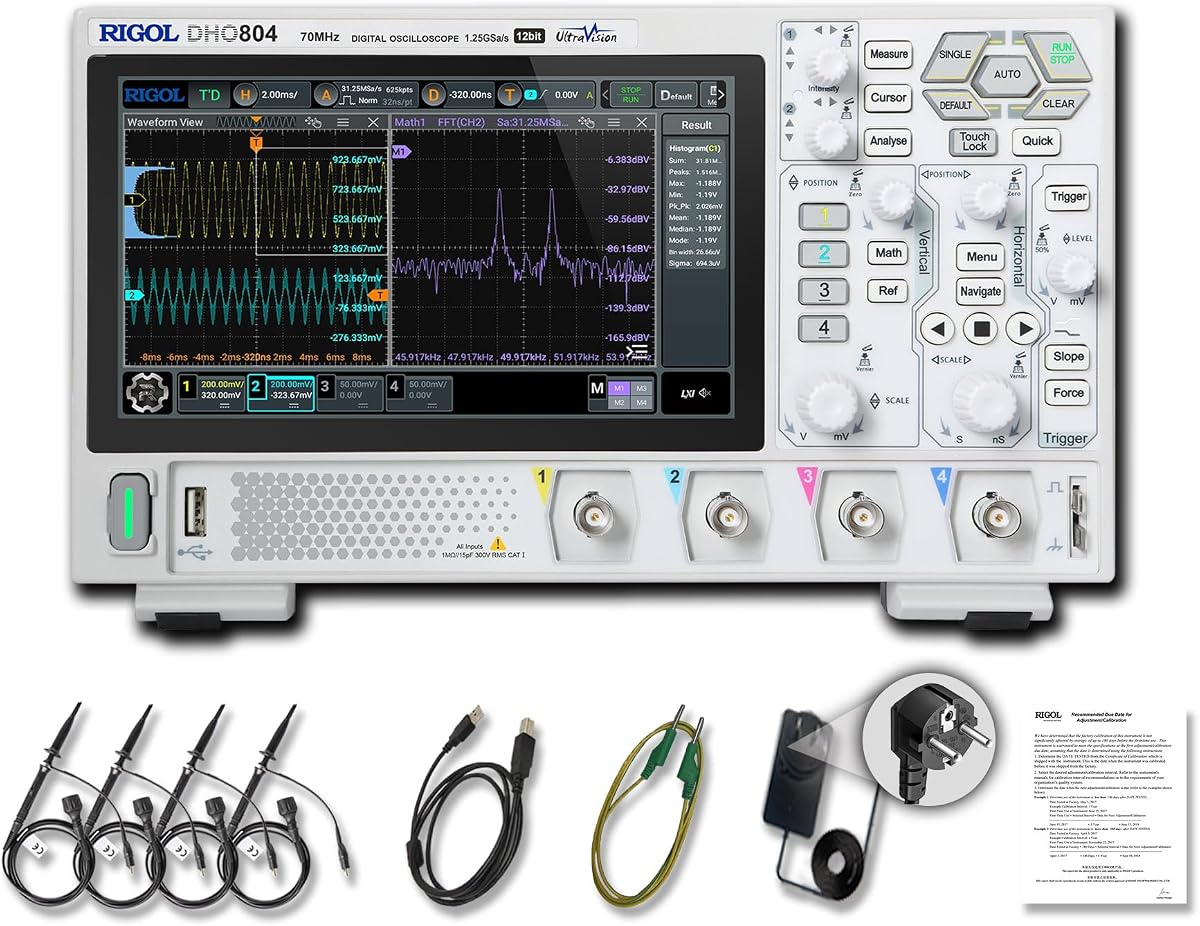
The RIGOL DHO804 delivers professional-grade features with 12-bit resolution and four channels. It offers a 70MHz bandwidth and massive memory depth for detailed analysis. This makes it excellent for debugging complex embedded systems and power electronics.
We may earn a commission when you buy through this link, at no additional cost to you.
Its UltraAcquire mode captures over one million waveforms per second. Serial decode supports protocols like CAN and SPI without extra probes. The 7-inch touchscreen simplifies navigation, and Flex Knob allows rapid adjustments. Connectivity options include LAN and HDMI for documentation.
The higher price and lack of built-in battery limit its portability. It is primarily designed for lab or benchtop use. However, the precision and multi-channel capabilities justify the investment. It remains a top choice for rigorous development work.
Engineers developing embedded systems or power converters will benefit from its depth. The high resolution reveals noise that standard scopes miss. For projects requiring precise multi-rail correlation, this device provides unmatched clarity and accuracy for professional tasks.
With 12-bit vertical resolution, this scope captures subtle voltage differences, essential for low-noise power supply analysis.
Standard serial triggers and decoders support common interfaces like SPI and I2C, simplifying embedded system debugging.
We may earn a commission when you buy through this link, at no additional cost to you.
The FNIRSI 2C53P combines a 50MHz oscilloscope with a multimeter and signal generator in one chassis. Its 4.3-inch IPS touchscreen offers intuitive control for measurements. This model aims to enhance workflow efficiency for automotive and electronics maintenance.
We may earn a commission when you buy through this link, at no additional cost to you.
It supports 500MS/s sampling and 12 waveform outputs. The 4000mAh battery ensures extended field operation. FFT analysis and X-Y mode aid in deep signal comparison. The capacitive touch simplifies parameter adjustments and cursor measurements significantly.
The heavier build might affect portability compared to smaller units. Users may need time to adapt to the touch interface. However, the large display improves readability in bright conditions. These trade-offs are manageable for users prioritizing screen real estate.
Field technicians who need large visuals and multiple functions will appreciate this unit. It suits automotive diagnostics where clear graphs are crucial. The integrated tools reduce equipment load, making it a convenient choice for varied repair scenarios.
A 4.3-inch high-resolution touch screen provides clear visibility, reducing eye strain during prolonged diagnostic sessions.
A 4000mAh battery supports about four hours of continuous work, ensuring reliability during extended field operations.
We may earn a commission when you buy through this link, at no additional cost to you.
The FNIRSI 1013D Plus offers a 100MHz bandwidth and 1GSA/s sampling rate for detailed waveform capture. Its 7-inch high-resolution touchscreen enhances usability for complex measurements. This model is ideal for users needing high-speed analysis in a portable format.
We may earn a commission when you buy through this link, at no additional cost to you.
It supports 1GB storage for thousands of screenshots and waveforms. The touch gestures and cursor measurements streamline operation. Lissajous graphics help compare phase and frequency visually. The 6000mAh battery sustains four hours of operation for field use.
The size and weight make it less pocket-friendly than smaller models. Touchscreen handling requires precision to avoid accidental inputs. However, the speed and display quality provide significant advantages. It balances power with mobility effectively for modern tasks.
Users needing high-speed digital signal analysis will find this model valuable. The large display and storage simplify documentation. It is suited for educators and engineers who require clear visuals for presentations. This device delivers professional performance in a portable design.
A 1GSA/s sampling rate captures fast edge transitions, essential for accurate digital signal and glitch analysis.
Up to 1000 screenshots and waveform sets can be stored, facilitating easy documentation and side-by-side comparisons.
We may earn a commission when you buy through this link, at no additional cost to you.
The FNIRSI 2C23T is a highly rated compact device combining a 10MHz scope with a multimeter. It features a 2.8-inch HD display and 3000mAh battery for extended standby. This model is perfect for basic troubleshooting in educational or hobbyist settings.
We may earn a commission when you buy through this link, at no additional cost to you.
It offers 50MSa/s sampling and seven standard waveform outputs. The FPGA architecture ensures stable signal capture. Its auto measurement functions and single-key adjustments simplify operations. The multimeter covers essential parameters like resistance and voltage efficiently.
The low bandwidth restricts use to low-frequency circuits. The small screen may be harder to read in bright light. However, the lightweight design and ease of use make it convenient for quick checks. These limits suit basic tasks effectively.
Educators and beginners needing a reliable starter tool will find this ideal. Its high rating reflects consistent performance and durability. It serves well as a secondary tool for simple circuit analysis. This device remains a strong entry-level option for many users.
A 4-digit 10000-count multimeter provides accurate readings for voltage, current, and resistance in one unit.
A 3000mAh rechargeable battery offers up to six hours of standby, ensuring availability for multiple daily tasks.
We may earn a commission when you buy through this link, at no additional cost to you.
The FNIRSI 2D15P integrates a 100MHz scope, TRMS multimeter, and DDS generator. With 500MS/s sampling and deep memory, it captures fine waveform details. The 4.3-inch touchscreen ensures intuitive control for precise measurements in professional environments.
We may earn a commission when you buy through this link, at no additional cost to you.
It includes auto-measurement, curve view, and afterglow features. The built-in 5000mAh battery supports extended field use. Quiet fan cooling maintains stability during long tests. The 13 parameters and 6 math functions enable advanced signal analysis and comparison.
Fan noise might interfere with sensitive environments. The interface may require learning time. However, the balanced feature set ensures robust performance. For technicians needing TRMS readings and deep memory, these trade-offs are acceptable.
Professionals requiring accurate RMS measurements will value this unit. The 100MHz bandwidth supports modern circuit testing. Its integrated design reduces the need for multiple devices. It remains a reliable choice for comprehensive electronics diagnostics and education.
True RMS measurement ensures accurate readings for non-sinusoidal waveforms, vital for reliable AC power diagnostics.
Six dedicated math functions and 13 parameters allow detailed waveform analysis, supporting complex troubleshooting tasks.
We may earn a commission when you buy through this link, at no additional cost to you.
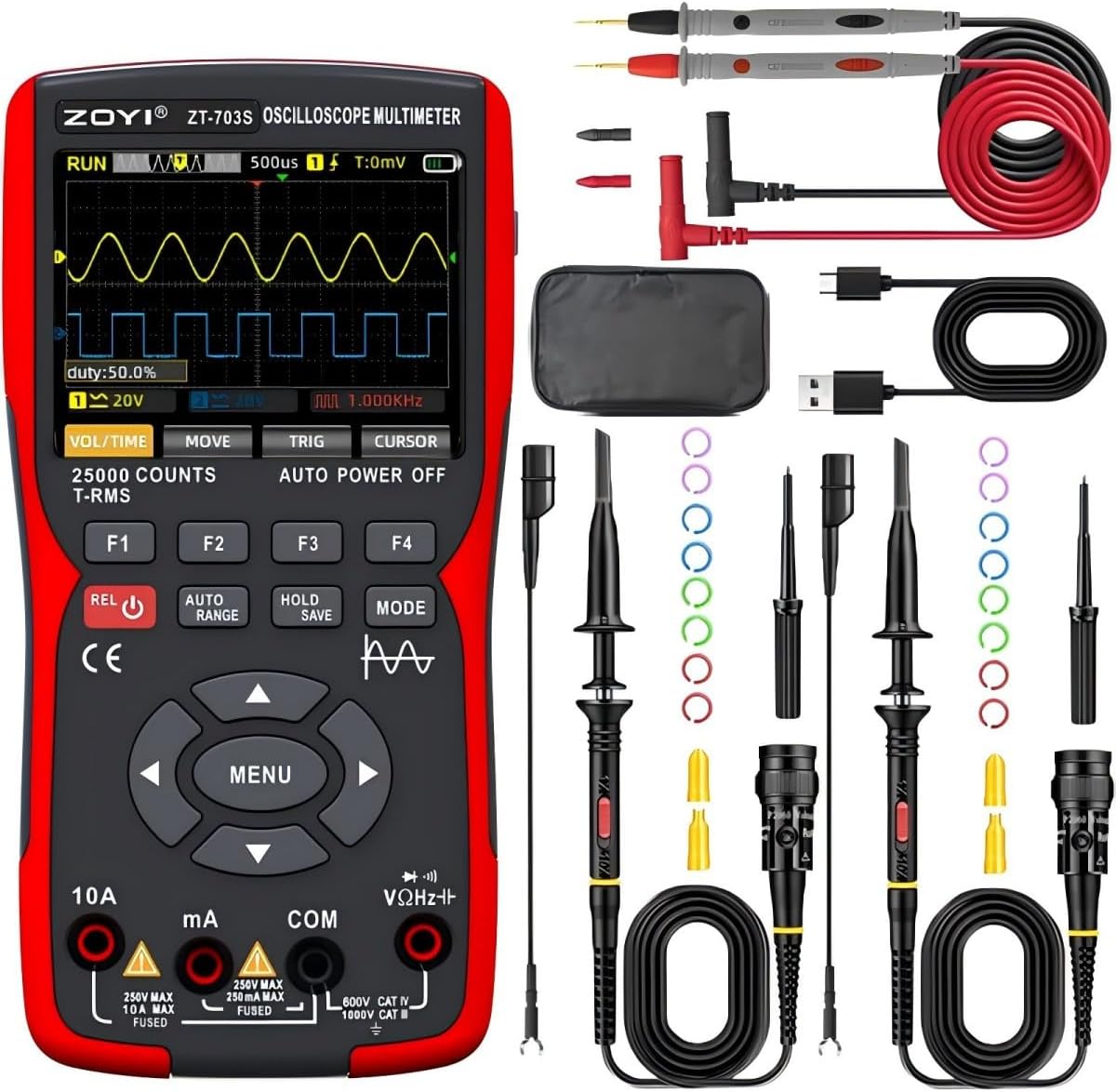
This generic 3-in-1 handheld oscilloscope offers a 50MHz dual channel scope with a multimeter and generator. It supports 280MSa/s sampling and 25000-count precision. The high rating reflects strong performance for automotive and general electronics diagnostics.
We may earn a commission when you buy through this link, at no additional cost to you.
It features auto waveform recognition for faster setup. The Type-C interface enables efficient data transfer and charging. Waveform images can be stored and output via the signal generator mode. This combination helps expand testing flexibility across various scenarios.
Users must read the manual for optimal setup due to complex menus. The added weight reduces portability. However, the high resolution and auto features simplify complex tasks. These trade-offs suit users prioritizing data precision over ultra-lightweight design.
Automotive technicians and educators will appreciate its versatile tool set. The high-resolution multimeter ensures accurate readings alongside waveform capture. It serves as a comprehensive diagnostic kit. This model is a practical solution for diverse testing environments.
An automatic recognition function identifies unknown waveforms, speeding up initial setup and measurement processes.
Type-C charging and data transfer allow quick exporting of waveforms for documentation and external analysis.
We may earn a commission when you buy through this link, at no additional cost to you.
Selecting the right oscilloscope requires balancing performance needs with budget constraints. Understanding key specifications helps you find a device that delivers reliable measurements without unnecessary complexity.
Bandwidth determines the maximum signal frequency the device can accurately capture. Higher bandwidth ensures you can measure fast pulses and high-frequency circuits without distortion. The sampling rate defines how many data points are taken per second, impacting waveform fidelity.
For general electronics, 50MHz is often sufficient. For audio or low-speed digital, 10MHz may suffice. Ensure the sampling rate is at least five times the bandwidth to avoid aliasing effects.
Channels allow simultaneous monitoring of multiple signals. Two channels are standard for comparing inputs, while four channels offer deeper debugging. Input voltage range indicates the maximum voltage the probe can safely measure.
Always check that the voltage rating matches your application. A 400V rating is common for automotive or mains testing. Single channel units work for basic checks but limit comparative analysis.
Larger displays improve waveform visibility, especially in bright environments. Touchscreens simplify navigation but may require calibration. Resolution affects the clarity of small details and grid lines.
A 7-inch screen offers excellent clarity but adds weight. Smaller screens like 2.8-inch are portable but harder to read. Choose based on where you will use the device most often.
Integrated multimeters and signal generators save space and cost. FFT analysis helps detect noise and harmonics. Auto setup functions reduce manual adjustments and training time.
Consider if you need spectrum analysis or serial decoding. These features are valuable for embedded development. Basic scopes may lack them but are cheaper.
Field work demands reliable power and lightweight design. Built-in batteries should last for at least four hours. USB-C charging is a modern standard that offers convenience.
Check standby time versus active usage time. A 3000mAh or higher battery supports extended shifts. Portable units may have smaller batteries but offer ease of transport.
Storage depth determines how long the scope can record signals. More memory allows deeper analysis of slow events or glitches. Export options like USB or SD cards help document findings.
Look for units that support waveform saving and screenshots. This is essential for reports or sharing results. Larger storage is preferred for detailed investigations.
Triggering stabilizes waveforms for clear viewing. Auto, normal, and single triggers handle different signal types. One-key auto functions are helpful for beginners.
Advanced users may prefer granular control over thresholds. Simple interfaces reduce learning time. Ensure the device supports the signal types you test most often.
Build quality matters in harsh environments. Look for high-voltage protection modules and rugged housing. Fan cooling keeps the unit stable during long sessions.
Devices designed for automotive or industrial use should tolerate shock and vibration. Check warranty terms for added security. Robust construction ensures longevity in tough conditions.
Before measuring, always calibrate the probe to ensure accurate readings. Connect the ground clip to a common ground point on your circuit to avoid noise. Adjust the vertical and horizontal settings to fit the waveform on the screen comfortably.
Use the auto setup function if available to quickly stabilize the signal. For complex tasks, manually set triggers to focus on specific edges. Save screenshots or data for future reference and troubleshooting documentation.
Store the device in a dry, cool place to protect the battery and electronics. Avoid exposing it to extreme temperatures or moisture. Clean the screen gently with a soft cloth and never use harsh chemicals.
For most general electronics work, a 50MHz bandwidth is sufficient to capture signals in digital and analog circuits. If you work with high-speed data lines or RF components, look for 100MHz or higher to avoid losing critical details during analysis.
Sampling rate defines how many data points the scope captures per second. A higher rate ensures smooth, accurate waveforms without distortion. For reliable results, the sampling rate should be at least five times the bandwidth you plan to measure.
Many budget scopes support up to 400V input, which covers standard mains voltages. Always use rated probes and follow safety precautions. Never connect a non-isolated device directly to live circuits without proper grounding.
Yes, most modern handheld models have built-in lithium batteries for portable use. Battery life typically ranges from four to six hours depending on usage. Always fully charge the device before field work to avoid interruptions.
Most models support USB or Type-C data transfer to a computer. You can save waveforms, screenshots, or settings to external storage. Check the manual for specific file formats and compatible software tools.
Touchscreens offer convenience and faster navigation but can be less precise in certain conditions. Physical buttons provide tactile feedback. Choose based on your preference and typical usage environment for optimal workflow.
This guide highlighted ten top oscilloscopes ranging from compact handhelds to advanced 350MHz units. Each option balances cost and capability for different needs, whether for basic checks or detailed signal analysis.
Prioritize bandwidth and channel count based on your project complexity. If portability matters, consider lighter models with strong battery life. For rigorous diagnostics, invest in units with high-resolution displays and FFT tools.
Always verify current prices and availability before purchasing as market conditions change. These devices offer significant value for hobbyists and engineers alike. With the right choice, you can ensure accurate and efficient testing for any electronics project.