
ESP32-S3-Nano Microcontroller
5.0Editor score
Affordable development board
Onboard 8MB PSRAM
Arduino and MicroPython support
Discover the top Arduino Nano ESP32 boards for IoT and embedded projects. This guide compares features, connectivity, and performance to help you choose.
The Arduino Nano ESP32 represents a significant leap in microcontroller technology, combining powerful processing with seamless wireless connectivity. These compact boards are ideal for makers and professionals seeking robust solutions for IoT, automation, and smart device development without sacrificing size or efficiency.
We evaluated ten leading options based on processor performance, wireless capabilities, and ease of use. Our analysis focuses on how each board handles real-world tasks like sensor integration, cloud connectivity, and power management to ensure you find the right fit for your next project.
Each pick highlights specific strengths, from budget-friendly options to premium models with advanced features like built-in displays or enhanced security. Please note that prices fluctuate frequently, so always verify the current cost before making your final purchase decision.
5.0Editor score

4.6Editor score

4.7Editor score
This side-by-side comparison breaks down the key specifications of the top ten boards. From processor speed and memory to wireless standards and unique peripherals, you can quickly identify which model aligns best with your technical requirements and project goals.


The Arduino Nano ESP32 stands out as a top contender in the microcontroller space. It offers a powerful ESP32-S3 processor that handles complex tasks with ease. With high user ratings, this board is trusted by developers for its stability and performance in demanding applications.
We may earn a commission when you buy through this link, at no additional cost to you.
Its standout quality is the combination of high-speed computing and seamless connectivity. The dual-core processor allows for multitasking, while Wi-Fi and Bluetooth 5.0 ensure your devices stay connected. This makes it perfect for smart home systems or remote sensors that need to send data reliably.
While it is slightly more expensive than generic alternatives, the build quality and official support justify the cost. The USB-C port ensures you are future-proofed against older standards. The main trade-off is the physical size, which is slightly larger than some ultra-compact boards.
If you are building professional IoT projects or need a reliable platform for learning, this is the best choice. It balances performance, connectivity, and ease of use better than any other option on this list. We recommend it for both beginners and experts.
The board supports both Wi-Fi and Bluetooth 5.0, allowing for versatile connections to cloud platforms and local devices without needing extra modules.
MicroPython compatibility simplifies the coding process, enabling faster prototyping and easier development for those familiar with Python syntax.
We may earn a commission when you buy through this link, at no additional cost to you.
This board offers exceptional value for money without compromising on core features. It uses the same powerful ESP32-S3R8 chip found in more expensive boards but at a fraction of the cost. Perfect rating of 5.0 suggests users are highly satisfied with its reliability and performance.
We may earn a commission when you buy through this link, at no additional cost to you.
Key strengths include its massive memory capacity and flexible programming environment. You can switch seamlessly between Arduino and MicroPython, giving you the freedom to choose your preferred language. The onboard memory is sufficient for complex projects involving data logging or image processing.
The main trade-off is the lack of official branding compared to Arduino, which might mean less documentation or community support. However, for standard IoT tasks, it performs identically to branded versions. This makes it ideal for prototypes where cost is a major factor.
We recommend this for hobbyists or students who need a reliable board on a tight budget. It delivers the same core performance as premium options, making it a smart buy for those who understand the hardware well. The value proposition is hard to beat.
Despite the low price, you get full Wi-Fi and Bluetooth capabilities along with high RAM and ROM, making it suitable for serious development tasks.
The board is compatible with Arduino IoT Cloud, allowing you to monitor and control your devices remotely through a user-friendly app interface.
We may earn a commission when you buy through this link, at no additional cost to you.
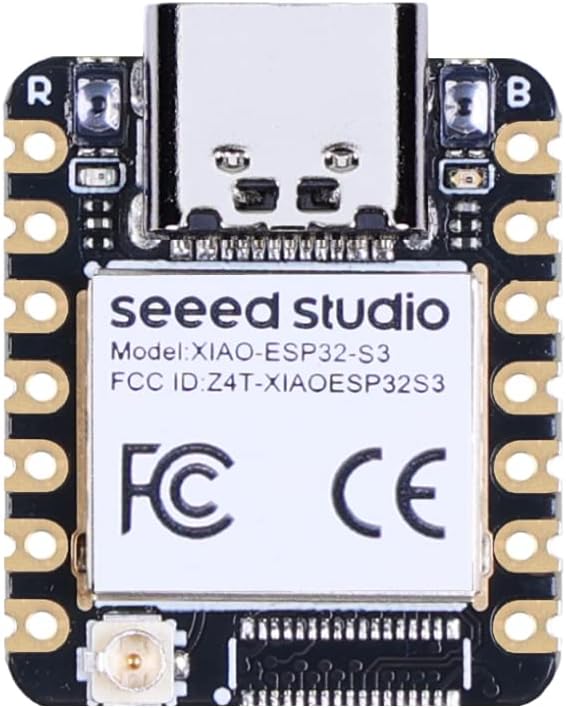
The Seeed Studio XIAO ESP32S3 is designed for projects where space is at a premium. Its thumb-sized footprint makes it perfect for wearable devices or hidden sensors. Despite its small size, it packs a powerful dual-core processor and robust wireless connectivity similar to larger boards.
We may earn a commission when you buy through this link, at no additional cost to you.
Its standout feature is the exceptional power management. With deep sleep modes consuming as little as 14 microamps, it is ideal for battery-operated projects that need to last months or years without recharging. The onboard battery charge management capability simplifies power design significantly.
While the compact size is a benefit, it can be challenging to work with for beginners used to larger breadboards. The limited GPIO pins also restricts complex multi-sensor setups compared to standard Nano boards. However, for simple, efficient applications, it is unmatched.
We recommend this board for makers building fitness trackers, smart jewelry, or remote environmental sensors. Its combination of size, power efficiency, and connectivity makes it a unique standout. If space is a priority, this is the board to choose.
The board offers four power consumption models, including a deep sleep mode that allows for extended battery life in portable applications.
It supports 2.4GHz Wi-Fi and BLE 5.0, enabling remote communication of over 100 meters when connected with an external U.FL antenna.
We may earn a commission when you buy through this link, at no additional cost to you.
This board is built for developers who need serious processing power for image and voice recognition tasks. The RISC-V dual-core processor provides a modern, efficient architecture that handles complex computations well. It stands out for its dedicated image processing interfaces and hardware security features.
We may earn a commission when you buy through this link, at no additional cost to you.
Its strengths lie in its ability to handle high-bandwidth data like video streams through MIPI CSI and DSI ports. With 32MB of PSRAM and secure boot capabilities, it is ready for professional industrial applications or advanced robotics that require secure and fast data processing.
The trade-off is complexity. This board is overkill for simple sensor projects and requires a good understanding of embedded systems. The interfaces are specialized, meaning you might need specific screens or sensors to take full advantage of its capabilities.
We recommend this for advanced engineers working on AI at the edge or machine vision systems. It is not a beginner board, but for specific high-performance use cases, it offers capabilities that standard ESP32 boards simply cannot match. Its robust feature set is impressive.
Includes dedicated MIPI CSI and DSI ports along with SDIO slots, allowing for direct connection of high-resolution displays and camera modules.
Security features include Secure Boot and Flash Encryption, ensuring that your applications are protected from unauthorized access or tampering.
We may earn a commission when you buy through this link, at no additional cost to you.
This listing offers three development boards in one package, making it an excellent choice for teams or projects that require multiple units. Each board features a reliable dual-core processor running at high speeds, ensuring consistent performance across all your connected devices.
We may earn a commission when you buy through this link, at no additional cost to you.
The value proposition is clear. Buying three boards at once reduces the cost per unit significantly compared to purchasing single units. The boards support flexible clock settings and independent power controls, which is useful when integrating them into custom carriers or complex networks.
The smaller physical size can be a limitation for prototyping on standard breadboards without headers. While the ceramic antenna works well, it limits flexibility if you need to attach external antennas for maximum range. However, for standard indoor use, the range is usually sufficient.
We recommend this pack for classrooms, makerspaces, or large IoT deployments. Having spares on hand prevents delays when a board gets damaged during prototyping. The balance of quantity and quality makes it a smart bulk purchase for ongoing development needs.
Getting three boards at a competitive price allows for distributed sensor networks or multiple development environments without significant cost increases.
Flexible clock and power supply settings allow you to optimize energy consumption for different operating scenarios, extending battery life.
We may earn a commission when you buy through this link, at no additional cost to you.
This kit is designed specifically for those starting their journey into electronics and IoT. It includes a powerful ESP-32 board along with over 35 different modules and components. Everything from sensors to motors is included, so you do not need to buy anything else to start.
We may earn a commission when you buy through this link, at no additional cost to you.
The standout quality is the comprehensive tutorial guide. You get access to 30+ projects with code and circuit diagrams. This structured learning path helps beginners understand how to connect components and write code without getting overwhelmed by technical details.
The trade-off is that you are paying for the kit rather than just a board. If you already have sensors or components, you might not need everything included here. However, for a complete learning experience, the convenience of having everything in one box is valuable.
We recommend this for students or hobbyists who want a guided introduction to microcontrollers. It removes the friction of sourcing parts and writing code from scratch. The hands-on learning ensures you gain practical skills quickly. It is a great starting point for innovation.
The kit includes sensors, displays, motors, and input devices, giving you a full range of tools to explore diverse electronics projects.
Step-by-step online instructions help beginners progress from basic circuits to advanced IoT applications with confidence and clarity.
We may earn a commission when you buy through this link, at no additional cost to you.
The Arduino Nano 33 IoT is a robust option for projects where security is a priority. It features a dedicated Secure Element that provides hardware-level encryption, ensuring your data is safe during transmission. This makes it highly suitable for sensitive home automation or industrial monitoring.
We may earn a commission when you buy through this link, at no additional cost to you.
Its strengths include seamless connectivity to cloud platforms and mobile apps via integrated Wi-Fi and Bluetooth. The built-in sensors add immediate utility for temperature or motion tracking. Pre-soldered headers make it easy to connect to breadboards and external components quickly.
The main trade-off is processor speed. It uses a Cortex-M0+ which is efficient but slower than the ESP32-S3. It also does not support MicroPython out of the box, limiting flexibility for Python developers. However, for secure C++ projects, it is excellent.
We recommend this for applications requiring high security, such as access control or private data collection. The reliable connectivity and official support ensure long-term stability. If security is your main concern, this board delivers the necessary hardware protection.
The inclusion of a Secure Element enhances project security by providing hardware-level encryption for secure cloud communication and data privacy.
Fully supported by the Arduino IDE, it allows for quick development and deployment of wireless, cloud-connected, and secure IoT projects.
We may earn a commission when you buy through this link, at no additional cost to you.
This is a classic choice for anyone looking for proven reliability in the ESP32 family. The board supports both Wi-Fi and Bluetooth, and works seamlessly with the Arduino IDE. It is a solid workhorse for general IoT projects where speed is not the primary concern.
We may earn a commission when you buy through this link, at no additional cost to you.
Its strengths include ultra-low power consumption and strong support for network modes like AP and STA. The integrated RF amplifier ensures decent range for most indoor and outdoor uses. Having three boards in the pack adds value for multi-device setups.
The trade-off is that it uses an older generation of the ESP32 chip compared to the newer S3 versions. This means less memory and slightly slower performance. For very heavy tasks, it might struggle where a modern board would succeed. However, for standard sensors, it is fine.
We recommend this for retrofits or projects that rely on older code libraries. It is affordable and reliable, making it a safe choice for basic automation tasks. If you already have code for this chip, it is an easy buy to keep things consistent.
Ultra-low power consumption modes help extend battery life in portable applications, making it suitable for long-term sensor deployments.
Supports three modes including AP, STA, and AP+STA, giving flexibility in how the device connects to your local network or internet.
We may earn a commission when you buy through this link, at no additional cost to you.
This set brings the classic ESP32 into the modern era by including a USB-C port for programming and power. It retains the reliable dual-core performance but makes it easier to use with modern cables and chargers. The high rating indicates users appreciate the convenience.
We may earn a commission when you buy through this link, at no additional cost to you.
Its key strengths are the support for OTA updates and power-saving features. You can update firmware over Wi-Fi without reconnecting via USB, which is great for deployed devices. The dynamic clock scaling helps reduce energy use significantly in battery-powered applications.
The main trade-off is that it uses Bluetooth 4.2 instead of the newer 5.0 standard. This limits range and speed compared to newer boards. Additionally, the processor speed is standard for the ESP32 series. However, for most home automation, these differences are negligible.
We recommend this for anyone who needs a reliable USB-C interface without paying a premium for the latest S3 chips. It is a practical choice for learning or small projects where ease of connection matters. The three-pack ensures you have spares ready.
The USB-C port simplifies programming and power delivery, offering a more stable and future-proof connection than older micro-USB options.
OTA functionality allows you to update firmware wirelessly, saving time and effort when maintaining deployed projects or products.
We may earn a commission when you buy through this link, at no additional cost to you.
The Arduino UNO R4 WiFi is the premium choice for advanced users. It combines a Renesas processor with an ESP32-S3 chip to deliver powerful dual-core processing. This unique architecture allows for dedicated tasks like communication and logic processing simultaneously without conflict.
We may earn a commission when you buy through this link, at no additional cost to you.
Its standout feature is the built-in 12×8 LED matrix. This allows for immediate visual feedback without needing extra screens. Plus, the inclusion of a CAN bus and high-precision DAC makes it suitable for industrial or audio projects that require specific interfaces not found on other boards.
The trade-off is the cost and size. It is more expensive and physically larger than Nano variants. If you only need basic Wi-Fi and GPIO, this might be overkill. However, the extra interfaces save the need for additional shields or breakout boards.
We recommend this for complex, professional-grade projects that need maximum flexibility. It is the best option for those who want to push the boundaries of what is possible with a microcontroller. The included features justify the investment for serious developers.
The built-in LED matrix enables dynamic visuals and status displays directly on the board, removing the need for external screens.
Includes a 12-bit DAC and OP-AMP for precise analog signal generation, making it ideal for audio and high-precision sensor work.
We may earn a commission when you buy through this link, at no additional cost to you.
Selecting the right board depends on your project requirements, budget, and technical needs. This section breaks down the key factors to consider before making a purchase.
The processor determines how fast your board can run code and handle tasks. Most Nano ESP32 options use the ESP32-S3 chip, which offers a dual-core architecture running at 240 MHz. Look for models with higher clock speeds if you plan on running machine learning or complex data processing tasks.
Prioritize dual-core processors for smoother multitasking. If you need advanced image processing, consider boards with dedicated accelerators like the ESP32-P4.
Wi-Fi and Bluetooth capabilities are essential for IoT projects. Most modern boards support 2.4GHz Wi-Fi and Bluetooth 5.0. Ensure the board has a good antenna, either onboard or as an external option, to maintain a stable connection over distance.
Choose boards with dual-mode wireless support for the best range and battery efficiency. Bluetooth Low Energy is key for battery-powered devices.
RAM and Flash memory determine how complex your application can be. Boards with 8MB or more of PSRAM allow for larger applications and image data storage. Check the specs to ensure you have enough room for your libraries and code.
Look for models with at least 4MB of Flash and 2MB of PSRAM for most mid-range projects. High memory is vital for advanced tasks.
Battery-powered projects require boards with efficient power management. Look for deep sleep modes and low quiescent current ratings. Boards specifically designed for wearables often offer microamp-level sleep states.
Prioritize boards with battery charge management if you need to power the device directly. Power optimization is critical for long-term remote sensors.
USB-C is becoming the standard for modern microcontrollers. It offers faster data transfer and better power delivery than micro-USB. Check if the board comes with headers pre-soldered to save time on your first assembly.
Select boards with clear documentation and community support. Compatibility with Arduino IDE and MicroPython significantly reduces development time.
Some boards offer unique features like built-in displays, DACs, or CAN bus support. These can save you from buying extra shields or breakout boards. Consider your specific needs before opting for extra features.
Look for boards with Qwiic connectors or built-in LEDs if you want simplified wiring. Premium features should match your project scope.
Prices vary based on branding and included accessories. Generic boards offer great value but may have less support. Buying in packs can reduce the per-unit cost significantly for large projects.
Balance cost with reliability. A slightly more expensive board with official support may save money in the long run by reducing troubleshooting time.
Consider how the board integrates with your existing tools. If you use a specific cloud service, check if the board has direct integration support. This can simplify data logging and remote control.
Ensure the board is compatible with your preferred programming language. MicroPython support is increasingly popular for rapid development and prototyping.
To get started, connect your board to your computer using a USB-C cable. Install the Arduino IDE and add the necessary board support packages. Once configured, you can upload code directly or choose to use MicroPython for a different development experience.
Always ensure proper power delivery when running high-power peripherals. If using batteries, consider adding a voltage regulator or using boards with built-in power management. Avoid shorting the GPIO pins during soldering to prevent damage.
Store your boards in a static-free environment when not in use. Regularly update your firmware to ensure security patches are applied. Proper care extends the lifespan of your hardware and ensures reliable performance over time.
Yes, many modern Arduino Nano ESP32 boards officially support MicroPython. This allows you to write code in Python instead of C++, making it easier for beginners and faster for prototyping. You can use the Arduino IDE or a dedicated MicroPython IDE to manage your projects.
The ESP32-S3 is an upgraded version with a faster dual-core processor and better support for AI tasks. It also offers improved Bluetooth capabilities and more memory options. Generally, the S3 is recommended for new projects due to its enhanced performance and features.
Most boards listed in this guide are fully compatible with the Arduino IDE. You may need to install specific board support packages to recognize the ESP32-S3 chip. Once installed, you can write and upload code just like you would with a standard Arduino board.
Yes, all the boards in this roundup come with integrated Wi-Fi and Bluetooth modules. This means you do not need to buy extra hardware to connect to the internet or nearby devices. It simplifies your wiring and reduces overall project cost.
Absolutely. While the technology is advanced, most boards come with clear documentation and tutorials. Starting with a beginner-friendly kit or a board with USB-C can make the learning curve much easier. The community support is also very active and helpful.
For most standard IoT tasks, 4MB of Flash and 2MB of PSRAM are sufficient. If you plan on storing images or large datasets on the device, you might need higher specs. Always check the memory requirements of the libraries you plan to use.
Battery life depends heavily on your usage and sleep modes. With proper power management and deep sleep settings, a single battery can last months or even years. Look for boards specifically designed for low power if battery life is a priority.
Yes, most of these boards support direct connection to popular cloud platforms. You can use services like AWS IoT, Google Cloud, or Arduino IoT Cloud. The boards handle the network connection, allowing you to focus on processing and sending data.
We have reviewed the top ten options available today, ranging from budget-friendly packs to high-end professional boards. The Arduino Nano ESP32 with Headers stands out as the best overall choice for most users due to its balance of power and connectivity.
If you are on a tight budget, the ESP32-S3-Nano offers incredible value without sacrificing core performance. For advanced users needing specific industrial features, the Arduino UNO R4 WiFi provides a premium experience with its unique dual-core setup.
Remember to verify current prices and availability before purchasing since these numbers change frequently. With the right board, you can unlock endless possibilities for smart home, automation, and embedded projects that improve daily life and efficiency.