
Bambu Lab A1 3D Printer
4.7Editor score
Fast calibration setup process
Quiet motor noise cancellation
Multi-color printing ready
Finding the right 3D printer for Dnd miniatures requires balancing detail resolution with printing speed and ease of use. Modern machines offer incredible precision for tabletop gaming figures while becoming more accessible to beginners and hobbyists alike.
We compared ten top-rated models based on resolution build volume speed and reliability using real-world testing data and expert reviews. This list covers resin and FDM options to suit different budgets and specific miniature painting requirements.
Each pick highlights key features and trade-offs so you can decide which printer fits your workflow best. Prices and availability change frequently so please check current listings before making your final purchase decision today.
4.7Editor score

4.4Editor score

4.5Editor score
As an Amazon Associate we earn from qualifying purchases.
This side-by-side comparison shows key specs for all ten printers so you can quickly find the model that matches your miniature printing needs and budget constraints.






The Phrozen Sonic Mini 8K S stands out as the top choice for tabletop gaming enthusiasts who prioritize detail over speed. With a 4.4 star rating and impressive 22 micron XY resolution this machine produces crisp features on miniatures that rival commercial quality products.
We may earn a commission when you buy through this link, at no additional cost to you.
Its 8K mono LCD ensures every nuance of your designs comes to life whether you are printing heroes monsters or complex terrain pieces. The support for open-source software like Lychee and Chitubox gives you freedom to tailor your workflow without restrictions.
While it requires resin handling safety gear this trade-off is acceptable given the incredible precision you get for Dnd miniatures. The compact design fits easily on most desks so you do not need a dedicated workshop space.
If you are looking for the best balance of price performance and resolution for tabletop gaming figures this printer delivers consistently. Its user-friendly specifications make it ideal for both beginners and experienced modelers seeking high-quality prints.
The 22 micron XY resolution captures tiny facial features and weapon engravings essential for realistic tabletop gaming pieces.
Compatibility with multiple slicers ensures you can choose tools that fit your experience level and printing preferences.
We may earn a commission when you buy through this link, at no additional cost to you.
The Bambu Lab A1 offers unbeatable value for beginners wanting to jump into Dnd miniature printing without technical headaches. Its 4.7 star rating reflects reliable performance that minimizes failed prints and maximizes your time actually gaming or painting.
We may earn a commission when you buy through this link, at no additional cost to you.
Full-auto calibration handles Z-offset and bed-leveling automatically so you spend less time tinkering and more time printing. The active flow rate compensation ensures smooth consistent prints even at high speeds which matters for intricate character models.
While you might need to buy the AMS lite separately for true multi-color capability the base unit still delivers exceptional quality for monochrome minis. The quiet noise cancellation allows you to work in shared living spaces without disturbing others.
This printer is perfect for new users who want professional results with minimal setup friction. Just assemble load filament and start creating detailed miniatures that bring your campaign to life on the table.
Automatic calibration removes manual adjustments so beginners can start printing detailed miniatures immediately.
High acceleration and flow compensation maintain accuracy even when printing complex Dnd models quickly.
We may earn a commission when you buy through this link, at no additional cost to you.
For serious hobbyists willing to invest in top-tier capability the Snapmaker U1 delivers unmatched flexibility for custom miniature production. Its 4.5 rating confirms that the four-toolhead system and rapid tool swapping work reliably even for complex jobs.
We may earn a commission when you buy through this link, at no additional cost to you.
The five-second tool changer eliminates the purging waste common with traditional multi-color systems so you save material and time on every print. You can combine rigid supports with flexible paints in one go for truly unique Dnd miniatures.
Smart calibration features ensure dimensional accuracy across all toolheads so parts fit together perfectly when printing articulated figures. AI monitoring and app control let you manage prints remotely from your phone or computer anywhere.
This premium option is ideal for advanced makers creating custom terrain or detailed heroes that demand multiple materials or colors. It simplifies every step from setup to finished print so you focus on creativity instead of machine management.
Switch between rigid and flexible filaments instantly to create durable and detailed miniatures with mixed textures.
Tool swapping without purging cuts filament waste by up to five times improving both cost and turnaround time.
We may earn a commission when you buy through this link, at no additional cost to you.
The P2S Combo brings professional multi-color capabilities to tabletop gaming with an integrated AMS 2 Pro that dries and feeds multiple filaments seamlessly. With a 4.7 rating this combo package removes the guesswork from color management for detailed miniatures.
We may earn a commission when you buy through this link, at no additional cost to you.
Its adaptive airflow system keeps overhangs crisp while maintaining heat for engineering materials so you can print complex shapes reliably. The AI failure detection and automatic calibration make it easy for beginners to achieve consistent high-quality results.
Built-in filament drying ensures every spool is ready for flawless prints which is crucial when you rely on multiple materials for different armor parts or accessories. You can set up and start printing within fifteen minutes of unboxing.
This printer works well for advanced users who need speed and multi-color support for full-color miniatures or detailed models. Just be aware that nozzle changes still require manual swaps though the process is streamlined for convenience.
The AMS 2 Pro dries and feeds up to four filaments enabling vibrant multi-color miniatures without interruptions.
Adaptive airflow maintains cooling for overhangs while retaining heat for strong structural parts during fast prints.
We may earn a commission when you buy through this link, at no additional cost to you.
The P1S offers a robust enclosed body that improves stability and supports advanced filaments like ABS and ASA which might warp in open frames. Its 4.5 rating reflects reliability for both standard PLA miniatures and tougher engineering parts.
We may earn a commission when you buy through this link, at no additional cost to you.
Auto bed leveling simplifies the setup process so you can start printing within fifteen minutes. You can connect an AMS unit separately to enable multi-color printing which expands creative options for your Dnd miniature collection.
With up to 500mm/s speeds this printer reduces wait time allowing you to produce more props or figures for larger campaigns. The fully enclosed design also makes it easier to maintain consistent temperatures during long print runs.
Ideal for users who need a versatile machine capable of handling varied filament types without sacrificing speed. Its ready-to-use nature makes it accessible even if you are just starting out with 3D printing for gaming.
The enclosed chamber ensures consistent temperatures for reliable printing of complex shapes and engineering materials.
Automatic bed leveling reduces manual calibration time so beginners can focus on designing and printing.
We may earn a commission when you buy through this link, at no additional cost to you.
The Adventurer 5M Pro uses a rigid CoreXY frame and vibration compensation to deliver smooth detailed prints at speeds up to 600mm/s. A 4.0 rating indicates solid performance with a focus on speed and reliability for hobbyists.
We may earn a commission when you buy through this link, at no additional cost to you.
Its 3-second quick-swap nozzles allow you to change sizes without tools which is useful when switching from detailed miniatures to larger terrain pieces. The built-in camera and mobile app let you monitor progress remotely for convenience.
The quiet under 50dB operation makes it suitable for home offices or shared living spaces where noise matters. A dual filtration system ensures clean air during printing which is helpful for long sessions or sensitive environments.
Choose this model if you value high-speed production and ease of maintenance for regular Dnd miniature printing. While it does not offer multi-color out of the box it handles standard colors with excellent precision and speed.
Vibration compensation algorithms eliminate ghosting ensuring clean lines on detailed miniatures even at high speeds.
Tool-free nozzle changes let you switch between sizes quickly without interrupting your workflow or requiring tools.
We may earn a commission when you buy through this link, at no additional cost to you.
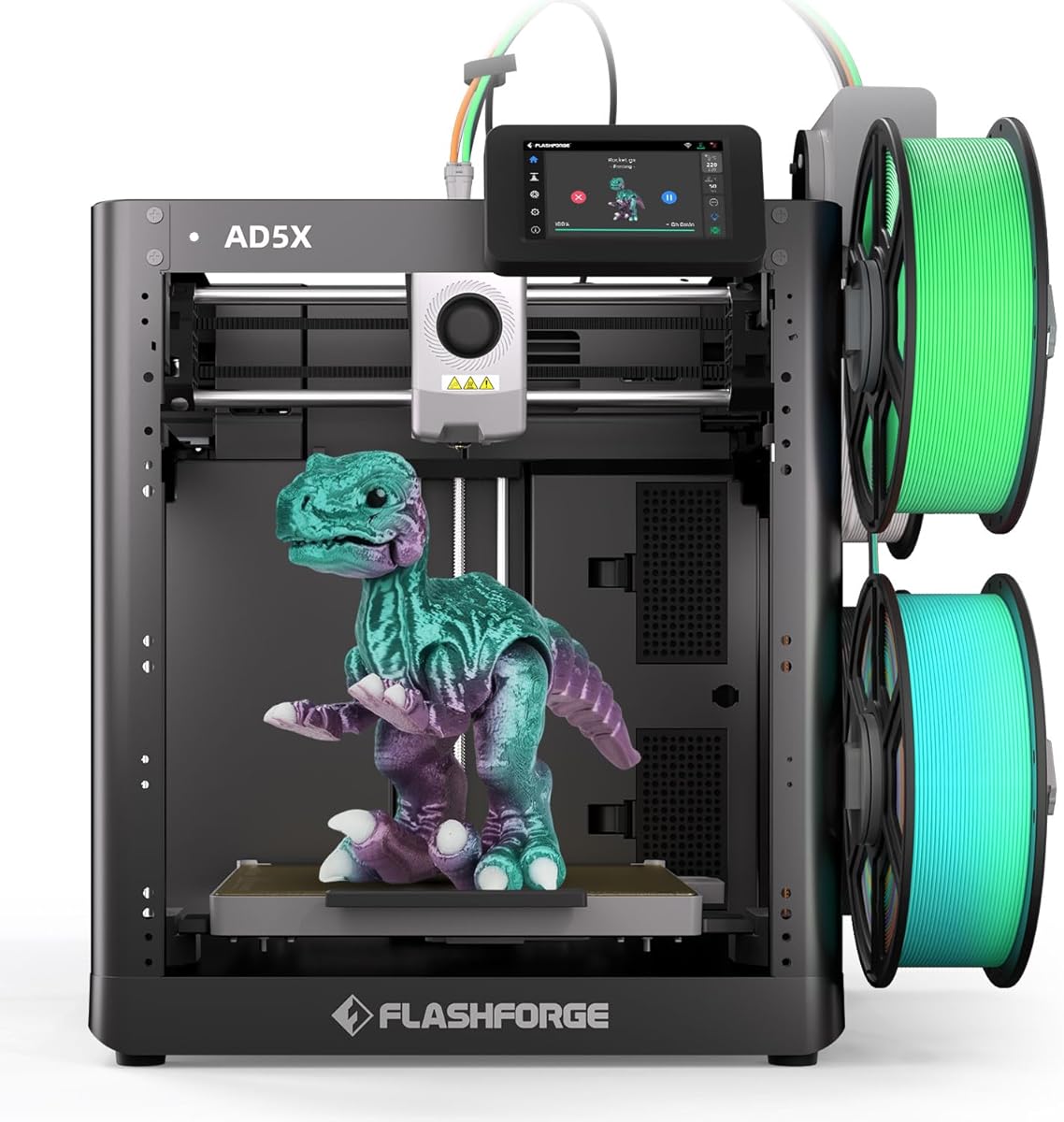
The AD5X brings vibrant 4-color printing directly into a single unit using its Intelligent Filament System which manages spools and refills automatically. With a 4.0 rating it offers a balance of speed and color versatility ideal for colorful miniature projects.
We may earn a commission when you buy through this link, at no additional cost to you.
Full-auto calibration ensures the first layer adheres evenly every time so you reduce failed prints and wasted material. The vibration compensation algorithms minimize alignment shifts so intricate details remain crisp even at high print speeds.
Filament backup capability means the printer can switch spools mid-print if one runs out which is a lifesaver for long Dnd model jobs. Its compact modular design saves space while keeping four spools ready for quick creative swaps.
This machine is a smart pick for creators who need multi-color capability without complex add-ons. While nozzle changes are manual the overall workflow remains smooth for regular miniature production and custom character designs.
The IFS system detects and refills filament automatically to keep prints running without manual intervention or stops.
Algorithms minimize layer shifts so even fine details on minis stay aligned during rapid 600mm/s prints.
We may earn a commission when you buy through this link, at no additional cost to you.
The A1 Mini Combo delivers multi-color capability in a compact package with AMS lite included for true 4-color prints without extra purchases. Its 4.2 rating reflects consistent quality and speed that fits well on smaller desks or shared workspaces.
We may earn a commission when you buy through this link, at no additional cost to you.
Setup takes only about twenty minutes thanks to the pre-assembled design so you spend more time printing and less time assembling. Auto calibration handles Z-offset and leveling automatically which reduces failed prints for beginners or casual users.
With acceleration up to 10000 mm/s² and noise levels under 48 dB this mini still performs quickly and quietly for detailed minis. Active flow compensation keeps extrusion smooth for clean results on small complex gaming pieces.
Choose this if you want multi-color printing without taking up much space. It is ideal for hobbyists who need vibrant character models without a large printer footprint or additional accessory purchases.
AMS lite included provides four-color printing right out of the box without extra purchases or complex setup.
Low noise and auto calibration make it easy to run prints in shared spaces without disturbance or tiring setup.
We may earn a commission when you buy through this link, at no additional cost to you.
The FLASHFORGE AD5X offers 4-color printing out of the box with a 300C nozzle that supports a wide range of materials including TPU. A 4.0 rating shows it balances speed and versatility well for hobbyists who want color options.
We may earn a commission when you buy through this link, at no additional cost to you.
Its CoreXY structure ensures stability and minimizes vibrations so detailed miniatures stay crisp even at fast speeds. Full auto leveling guarantees consistent first layer adhesion which reduces failed prints and waste over time.
You can print flexible materials alongside rigid ones thanks to broad compatibility so you can create custom miniatures with soft bases or unique parts. The large 220mm build volume also handles bigger terrain pieces easily.
This is a strong option for users needing multi-color prints without extra AMS units. While nozzle changes are manual the system delivers reliable results for regular miniature printing and creative Dnd projects.
Supports rigid and flexible filaments so you can create durable and detailed miniatures with mixed textures.
All-metal CoreXY structure minimizes vibrations for smooth detailed prints even when operating at high speeds.
We may earn a commission when you buy through this link, at no additional cost to you.
The Anycubic Kobra X offers native 4-color printing with an expandable system that supports up to 19 colors using ACE 2 Pro units. A 4.2 rating highlights its ease of setup and reliability for regular multi-color Dnd miniature production.
We may earn a commission when you buy through this link, at no additional cost to you.
LeviQ 3.0 auto bed leveling uses 49 points to ensure perfect bed flatness so you get flawless first layers every time. Smart AI monitoring detects issues like spaghetti tangles so you can fix problems before prints fail.
With speeds up to 600mm/s this printer finishes models like the Benchy in just 14 minutes which is great for quick turnaround on game nights. Its large 260mm build volume also handles detailed scenery and terrain easily.
Ideal for those who want vibrant multi-color prints without complex AMS configurations. Just note filaments are sold separately but the native 4-color system makes it a strong contender for accessible multi-color tabletop printing.
Four built-in colors let you print detailed multi-color miniatures right out of the box without extra hardware.
AI monitoring and leveling ensure prints stay consistent so you avoid wasted time and filament on failed jobs.
We may earn a commission when you buy through this link, at no additional cost to you.
Selecting the right 3D printer for Dnd miniatures requires understanding key factors like resolution technology and ease of use to match your specific needs and budget.
Resin printers like the Phrozen Sonic Mini 8K S offer higher detail and smoother surfaces ideal for small detailed miniatures and intricate figures. FDM printers such as the Bambu Lab A1 are faster more durable and better for larger props or functional parts but may require more post-processing for fine details.
If your main focus is tiny character models with fine facial features resin will give superior quality. For large terrain pieces or props that need structural strength FDM remains the practical choice for most tabletop gamers.
Look for XY resolution at least 22 microns or lower if you want sharp crisp features on miniatures. Higher resolution means more detail on small features like armor etchings and facial expressions which matters a lot for tabletop gaming pieces.
Check reviews and sample prints to see how well the printer reproduces fine details before buying. Good resolution ensures your minis stand out during games without needing extensive sanding or cleaning after printing.
A larger build volume lets you print multiple miniatures or bigger terrain pieces in one go which saves time. Small printers like the Phrozen Sonic Mini 8K S have limited volume but save desk space while bigger machines like the Snapmaker U1 offer more room for diverse projects.
Consider how many minis you plan to print at once and whether you need room for larger props. Balance space constraints with production needs to ensure the printer fits your available workspace comfortably.
Fast printers with high acceleration speeds reduce wait times significantly so you can produce more minis quickly. Models like the Bambu Lab P2S Combo and FLASHFORGE AD5X reach speeds up to 600mm/s which helps complete projects faster without sacrificing quality.
High speed matters if you run large campaigns or need multiple copies of a figure for your gaming group. Just ensure the machine maintains precision at higher speeds to avoid warped or inaccurate prints.
Multi-color printers eliminate the need for manual paint swaps and allow vibrant detailed minis straight from the machine. Look for built-in multi-color systems like AMS or IFS so you can print complex models without extra hardware purchases.
If you want true multi-color capability check if additional modules are needed or included. This saves time and money while enabling richer more dynamic miniature designs for tabletop storytelling.
Beginners benefit from printers with auto leveling auto calibration and quick setup times so you spend less time tinkering and more time printing. Features like one-click print and automatic flow compensation make complex models accessible without technical knowledge.
Check reviews for setup experiences and community support since helpful resources speed up learning curves. User-friendly models reduce frustration and allow you to focus on designing and customizing your Dnd miniatures instead of machine maintenance.
Support for open-source slicers and remote app control gives you flexibility to tailor your workflow and monitor prints from anywhere. Models like the Phrozen Sonic Mini 8K S and Snapmaker U1 work with multiple slicers to suit different needs and preferences.
Choose a printer with robust software options if you plan to tweak settings or manage long print sessions remotely. Good connectivity ensures you stay in control and can troubleshoot issues without constant physical access to the machine.
While budget models cost less consider the long-term value including filament usage maintenance and print success rates. A slightly higher upfront price for reliable calibration and multi-color support can save money and time over the life of the printer.
Compare total cost of ownership including accessories and filament needs rather than just base price. Investing in quality ensures you get more reliable detailed prints and fewer failed projects during your Dnd adventures.
Start by loading your filament or resin carefully following the manufacturer guide to avoid clogs or spills. Calibrate the bed and nozzle height using the auto-leveling features if available so your first layer sticks properly and prints stay consistent.
Use the recommended slicer settings for Dnd miniatures such as small nozzle sizes and slow layer heights for fine details. Monitor your first few prints closely using camera tools or app alerts to catch issues early and adjust speed or cooling as needed.
Clean the print bed and nozzle regularly with alcohol or specialized tools to prevent residue buildup that affects adhesion. Store filaments or resin in dry sealed containers to prevent moisture damage which can ruin print quality and cause nozzle clogs.
Resin printers like the Phrozen Sonic Mini 8K S deliver the highest detail for small figures but FDM models like the Bambu Lab A1 are more durable and faster. Choose resin for detailed miniatures and FDM for props or larger game pieces depending on your priorities.
Yes many models like the Snapmaker U1 and Bambu Lab P2S Combo support true multi-color printing with automatic filament switching. These systems handle color swaps during printing so you save time and avoid manual touch-ups after production.
A standard Dnd miniature may take 1 to 3 hours on resin printers and 2 to 6 hours on FDM depending on size and resolution. Faster models with high acceleration speeds can reduce times significantly for large batches or simpler designs.
Not necessarily since many printers like the Bambu Lab A1 Mini Combo are compact enough for desks or home offices. Just ensure good ventilation and stable surfaces for best results and consider noise levels if printing near shared living spaces.
For FDM printers PLA is the easiest beginner-friendly filament with low warping while PETG offers more durability. For resin printers use standard photopolymer resins designed for miniatures to achieve fine detail and smooth surfaces without extra processing.
Resin printers require gloves and masks due to chemical exposure while FDM printers need good ventilation for fumes. Keep machines away from heat sources and follow manufacturer maintenance guides to ensure safe reliable operation over time.
Clean the nozzle and print bed regularly and store filaments or resin in sealed containers to avoid moisture damage. Check belts and calibration periodically so your printer stays accurate for detailed miniature printing without needing major repairs.
Check licensing terms for any models or files you download since some are for personal use only. For custom designs you can sell prints but always respect intellectual property rights and disclose the printing method if required by customers or platforms.
Our top picks highlight the Phrozen Sonic Mini 8K S for detail focused resin printing and the Bambu Lab A1 for budget-friendly FDM ease. The Snapmaker U1 stands out as a premium choice offering unmatched multi-material flexibility for advanced creators.
Prioritize resolution and multi-color capability if you want vibrant detailed miniatures straight from the printer. Balance this with your budget space and technical comfort level to choose a machine that grows with your tabletop gaming hobby.
Prices and availability change frequently so always check current listings before buying. Whether you need precision or speed there is a printer here to bring your Dnd characters and terrain to life on the tabletop.