
HiLetgo 5pcs DHT11
4.5Editor score
Affordable multi-pack
Simple single-wire
Basic humidity support
This guide compares the top 10 Arduino temperature sensors for accuracy, durability, and ease of use in DIY electronics and professional monitoring projects.
Finding the right Arduino temperature sensor is crucial for any electronics project involving environmental monitoring. Whether you are building a weather station or a smart home device, accuracy and reliability matter greatly for success.
We evaluated ten top-rated sensors based on their specifications, user reviews, and compatibility with common microcontrollers. Each product was assessed for ease of integration, measurement range, and overall value for hobbyists and professionals alike.
Each pick in this list highlights key features and potential trade-offs to help you make an informed decision. Please note that product availability and pricing can change frequently, so verify details before purchasing.
4.5Editor score

4.7Editor score

4.9Editor score
This comparison table provides a quick overview of the key specifications for each of the ten selected products to help you choose the best fit for your specific application.




This module offers exceptional precision for both temperature and humidity monitoring tasks. With a rating of 4.7 stars, it stands out for its reliability and ease of integration into Arduino projects requiring accurate environmental data.
We may earn a commission when you buy through this link, at no additional cost to you.
The SHT31 sensor provides a wide measurement range from -40 to 125 degrees Celsius. Its I2C interface simplifies wiring compared to single-wire sensors, allowing for faster data transmission and support for multiple devices on the same bus.
While it costs more than basic options, the improved accuracy and wide voltage range justify the investment. It is ideal for projects where precise readings are critical for safety or functionality.
If you need a dependable sensor for professional or advanced hobbyist applications, this set of three modules offers excellent value. It balances performance and price effectively for most serious DIY electronics needs.
The +/- 0.3 Celsius accuracy ensures you get reliable data for sensitive applications like incubators or server rooms.
Operating between 2.4V and 5.5V makes it compatible with various microcontrollers without needing extra voltage regulators.
We may earn a commission when you buy through this link, at no additional cost to you.
The DHT11 remains a staple for budget-friendly environmental monitoring. This pack of five modules ensures you have spares for multiple projects. It scores a 4.5 rating due to its simplicity and low cost for basic Arduino temperature sensor tasks.
We may earn a commission when you buy through this link, at no additional cost to you.
It operates on a single-wire protocol which reduces pin usage on your microcontroller. The temperature range is limited to 0-50 degrees Celsius and humidity from 20-90 percent which covers most indoor use cases effectively.
The trade-off is lower accuracy compared to higher-end models. However for learning electronics or prototyping where exact precision is less critical, this sensor provides ample functionality without breaking the bank.
For students or hobbyists just starting out, this is the perfect entry-level choice. You get plenty of units to experiment with and build various prototypes using standard Arduino libraries.
The included wires and simple wiring scheme make it easy to connect without extra components or complex setups.
Buying five units at once ensures you have replacements ready for future projects or accidental damages.
We may earn a commission when you buy through this link, at no additional cost to you.
This set delivers professional-grade performance with its waterproof design and high accuracy. The 4.9 rating reflects its durability and ease of use in challenging environments. It is an ideal choice for monitoring liquids or outdoor conditions where robustness is key.
We may earn a commission when you buy through this link, at no additional cost to you.
The stainless steel probe ensures the sensor withstands corrosion and physical impact. With a temperature range extending from -55 to 125 degrees Celsius it handles extreme conditions that other sensors might fail under without issue.
While it does not measure humidity the precision of the temperature reading is outstanding. The kit includes adapter boards and resistors simplifying the integration process significantly for Arduino and Raspberry Pi users.
Choose this if you need a rugged sensor that can survive submersion or harsh weather. It is perfect for fish tanks, greenhouses, or industrial equipment monitoring projects.
The corrosion-resistant housing allows for continuous submersion in wet environments without damaging the internal electronics.
Included jumper wires and resistors mean you can start wiring immediately without needing to source extra parts.
We may earn a commission when you buy through this link, at no additional cost to you.
The AHT30 brings modern performance to indoor monitoring tasks. With a perfect 5.0 rating it excels in accuracy and stability for typical room conditions. It is particularly useful for applications requiring simultaneous access to multiple sensors via I2C.
We may earn a commission when you buy through this link, at no additional cost to you.
Its voltage range adapts easily to different power sources without complex regulation. The fast transmission speed ensures you get real-time updates for dynamic environments like HVAC systems or smart home devices.
The 4-pin test line connection makes physical setup straightforward for users. While it does not reach the high temps of the DS18B20 it covers the necessary range for most consumer electronics applications.
Select this for home automation projects where humidity data is just as important as temperature. It offers a reliable upgrade from older sensor models with minimal wiring changes needed.
Digital output and calibrated sensors ensure consistent readings over long periods without needing recalibration.
Low power draw makes it ideal for battery-powered devices running on limited energy sources.
We may earn a commission when you buy through this link, at no additional cost to you.
This set is designed for remote monitoring where the Arduino cannot be close to the sensor. The one-meter cable allows flexible placement in tanks or hard-to-reach equipment. It earns a 4.4 rating for its utility in industrial or hobbyist setups.
We may earn a commission when you buy through this link, at no additional cost to you.
The adapter module simplifies connection to microcontrollers by integrating the pull-up resistor. This reduces wiring complexity and ensures reliable communication on the 1-Wire bus without extra soldering or components.
While the cost is higher than bare probes the convenience of the pre-assembled kit saves time. It is especially useful for multi-zone monitoring where you need to place probes in different locations.
Use this for aquariums or machinery where distance is a factor. The waterproof design ensures durability even if the probe is submerged in water or moisture.
The one-meter lead lets you mount the sensor away from the electronics in dry or protected areas.
Pre-wired modules mean you can plug directly into your board without manual resistor installation.
We may earn a commission when you buy through this link, at no additional cost to you.
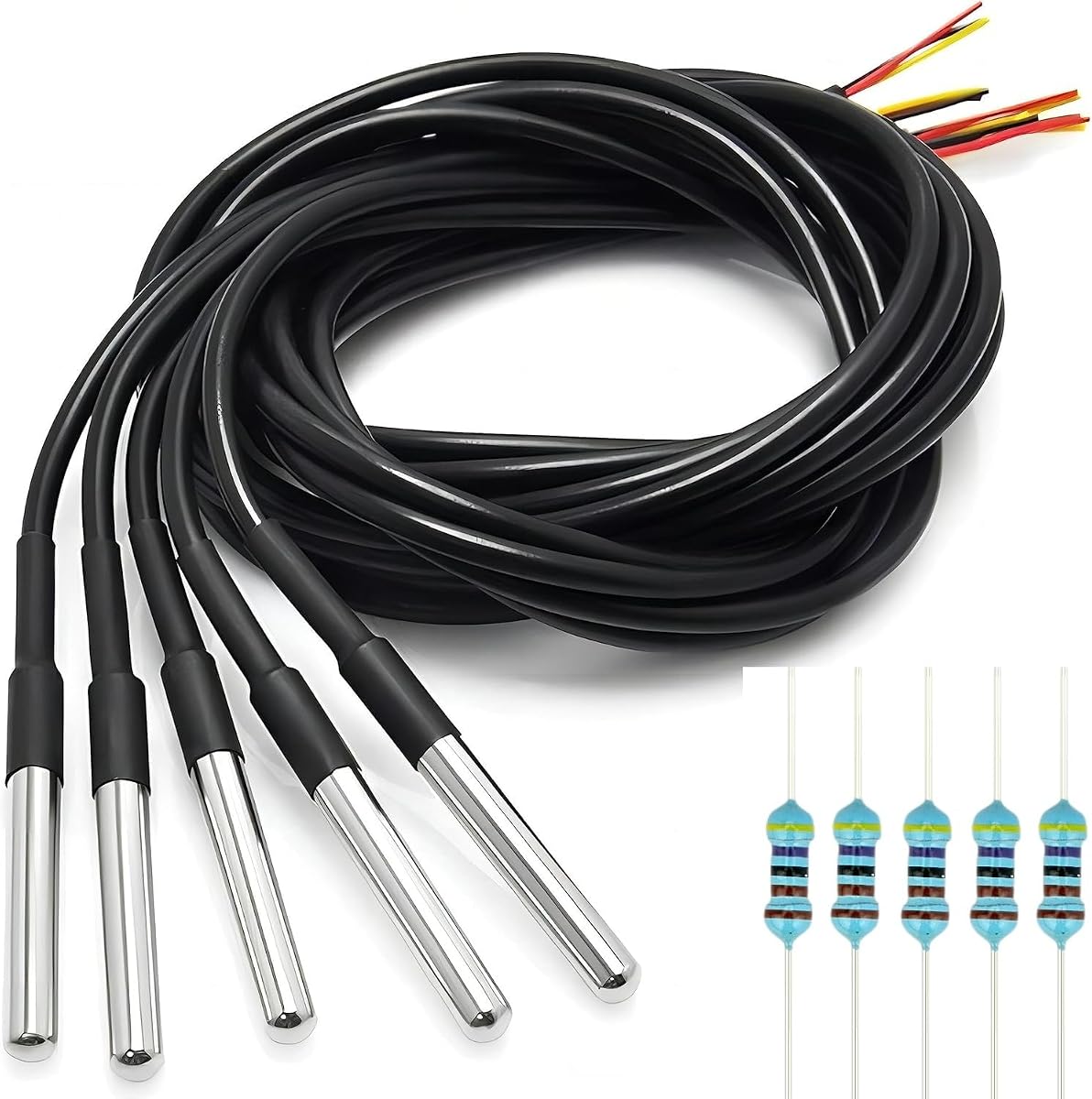
For extensive projects needing multiple zones this bundle offers great value. It includes five waterproof probes and resistors to cover all connections. The 4.4 rating highlights its reliability across a range of DIY electronics platforms like Arduino and ESP32.
We may earn a commission when you buy through this link, at no additional cost to you.
The sensors operate reliably in wet conditions without risk of damage. With a temperature range from -55 to 125 degrees Celsius they are suitable for both freezing and hot environments.
While you will need to wire them manually the inclusion of resistors streamlines the process. This option is best for those comfortable with basic soldering or breadboarding setups.
Choose this if you need multiple sensors for a large system. It provides the flexibility to monitor several areas simultaneously without purchasing extra components separately.
Having resistors included ensures you have what you need to stabilize the 1-Wire communication line.
Compatible with various microcontrollers making it versatile for different project architectures.
We may earn a commission when you buy through this link, at no additional cost to you.
This smaller pack is perfect for simple indoor projects like weather stations. With a 4.3 rating it offers basic functionality that works well for casual users. The sensors support both Arduino and Raspberry Pi without extra adapters.
We may earn a commission when you buy through this link, at no additional cost to you.
The single-wire protocol simplifies connections significantly for beginners. It measures humidity and temperature within a safe indoor range providing adequate data for general monitoring needs.
It may not suit high-precision industrial needs but is sufficient for home automation. The included wires reduce the need to source additional components for quick testing and prototyping.
Use this for basic hobby projects where cost matters most. It is an efficient choice for testing environmental conditions in a controlled setting.
Simple digital output makes it easy to integrate into code libraries designed for standard hobbyists.
Works seamlessly with Raspberry Pi and Arduino boards for versatile project development.
We may earn a commission when you buy through this link, at no additional cost to you.
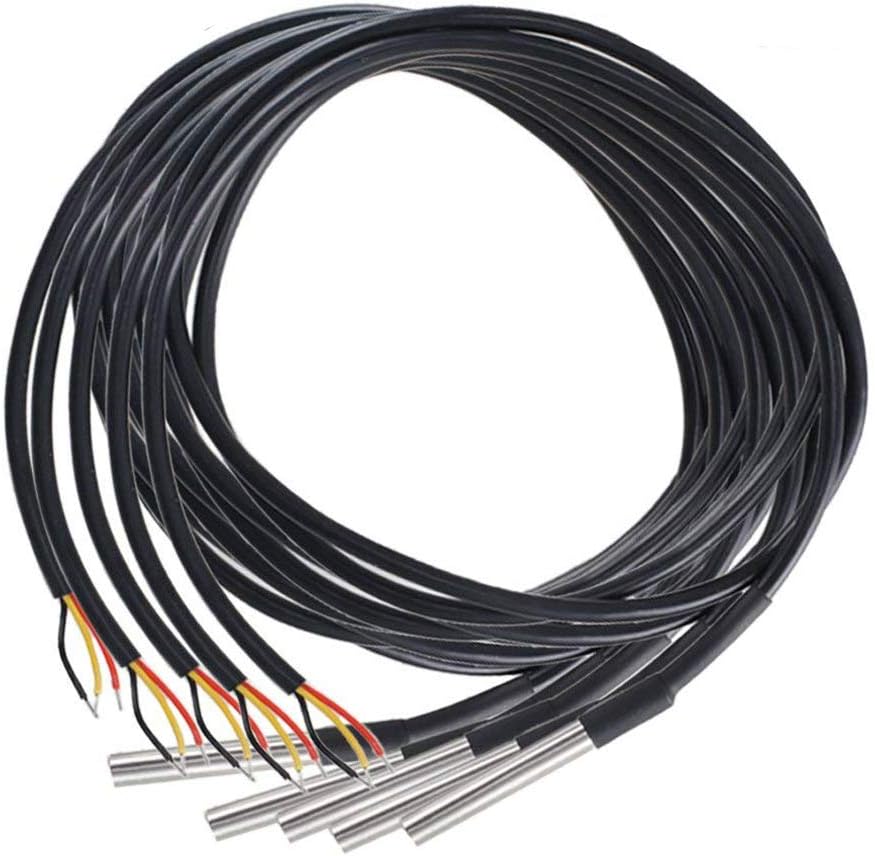
This bulk pack provides excellent coverage for large scale monitoring needs. With five waterproof probes and one meter cables you can monitor multiple zones effectively. The 4.5 rating reflects its solid performance for industrial or home applications.
We may earn a commission when you buy through this link, at no additional cost to you.
The probes are built to withstand water immersion without issue. They use a single bus interface which keeps wiring clean and organized even with multiple sensors connected to one microcontroller.
You will need to add external pull-up resistors which might add a small step to setup. However the benefit of having extra sensors for redundancy outweighs this minor inconvenience.
Ideal for greenhouses or water tanks where multiple readings are needed. It ensures you have enough probes to monitor every critical area of your system.
Stainless steel casing prevents rust and corrosion when used in aquatic or humid environments.
Five sensors allow for multi-point monitoring without needing extra purchases later.
We may earn a commission when you buy through this link, at no additional cost to you.
This sensor offers improved accuracy over the DHT11 for those needing more precision. It measures from -40 to 80 degrees Celsius and covers full humidity range. The 4.4 rating acknowledges its reliable performance for intermediate electronics projects.
We may earn a commission when you buy through this link, at no additional cost to you.
The chip uses an AM2302 component which provides stable readings over time. It is designed for digital output making it easy to read data using standard libraries without complex analog processing.
Fixing screw holes allow for secure mounting in permanent installations. While it does not include extra resistors the setup is straightforward for experienced users.
Choose this when you need a balance of cost and performance. It is suitable for weather stations where accuracy matters more than raw speed.
Lower minimum temperature allows it to work in colder environments than standard indoor sensors.
Capable of measuring up to 100% relative humidity for diverse weather conditions.
We may earn a commission when you buy through this link, at no additional cost to you.
This final pick offers a reliable bulk solution for multiple sensor applications. With five stainless steel probes you can cover extensive areas without gaps. The 4.5 rating confirms its durability and performance in real-world conditions.
We may earn a commission when you buy through this link, at no additional cost to you.
The waterproof design ensures the sensor works even when fully submerged. Operating from 3 to 5.5 volts it fits easily into standard Arduino power schemes without needing a battery pack.
You will need to add a pull-up resistor for stable data reading. This is a minor step that ensures the sensor communicates correctly with your microcontroller.
Use this for projects requiring multiple probes like water tanks or ovens. It delivers consistent readings across various environments with a sturdy build.
Stainless steel casing protects internal components from physical damage and harsh environmental exposure.
Standard red yellow and black wires make identification easy during wiring and troubleshooting.
We may earn a commission when you buy through this link, at no additional cost to you.
Selecting the right sensor depends on your specific project needs including accuracy, range, and environmental conditions.
Check the minimum and maximum temperatures the sensor can measure. If your project involves freezing or high heat ensure the sensor supports these extremes.
Always choose a sensor with a range slightly beyond your expected operating conditions.
Precision varies widely between models. Budget sensors might have an error of 2C while premium ones offer 0.3C.
Prioritize accuracy for applications like scientific experiments or safety monitoring where small errors matter.
Sensors use digital interfaces like I2C, 1-Wire, or serial protocols. Ensure your Arduino has enough pins to support the protocol.
I2C is great for multiple devices on fewer pins while 1-Wire is ideal for temperature-only setups.
If placing sensors outdoors or in water choose waterproof or stainless steel options.
Look for probes rated for submersion or weather resistance to avoid damage from moisture.
Some sensors measure only temperature while others include humidity readings.
If tracking climate data pick a combo sensor to simplify your wiring and reduce costs.
Verify voltage requirements match your microcontroller power. Most work on 3.3V or 5V.
Select models with wide voltage ranges if you plan to use battery power or solar setups.
Higher price usually means better accuracy and durability. Assess if you need high-end specs for your specific task.
For learning and prototyping budget options often suffice until you upgrade to better sensors.
Check if resistors or adapter boards are included. This can save time and prevent extra purchases.
Pre-assembled kits are easier to use for beginners than bare sensor modules.
Start by connecting the power pins to the 3.3V or 5V pin on your Arduino. Ground the sensor to the GND pin to complete the circuit.
Connect the data pin to a digital input pin on your microcontroller. Use a pull-up resistor if required by the specific sensor model.
Upload a compatible library code to read the data. Calibrate the sensor if necessary for precise measurements in your environment.
Choose the DHT22 or SHT31 for their wider temperature ranges and humidity support. Ensure the device is in a shaded enclosure to avoid direct sunlight affecting readings.
Yes, especially with I2C or 1-Wire sensors. You can connect multiple sensors to the same pins and read them individually in your code to monitor different zones.
Yes, a 4.7K ohm resistor is required between the Data and VCC pins for stable communication. Some adapter modules include this internally so check the product description.
DHT22 offers better accuracy and a wider temperature range compared to DHT11. It is better suited for projects requiring precise climate data while DHT11 is cheaper for basic tests.
Only specific DS18B20 probes with stainless steel or plastic casing are waterproof. Standard modules like DHT11 are not waterproof and should be kept dry indoors.
Connect the VCC to 5V or 3.3V and GND to Ground. The data pin can go to any GPIO pin. Use a library like Adafruit DHT for easy integration with your code.
We reviewed ten top sensors ranging from budget-friendly DHT11 modules to high-precision SHT31 and DS18B20 waterproof options.
Prioritize accuracy and environmental protection if your project involves extreme conditions. Otherwise a standard module might be sufficient for simple indoor tasks.
Always verify the current price and availability before purchasing to ensure you get the best value for your specific electronics project.