
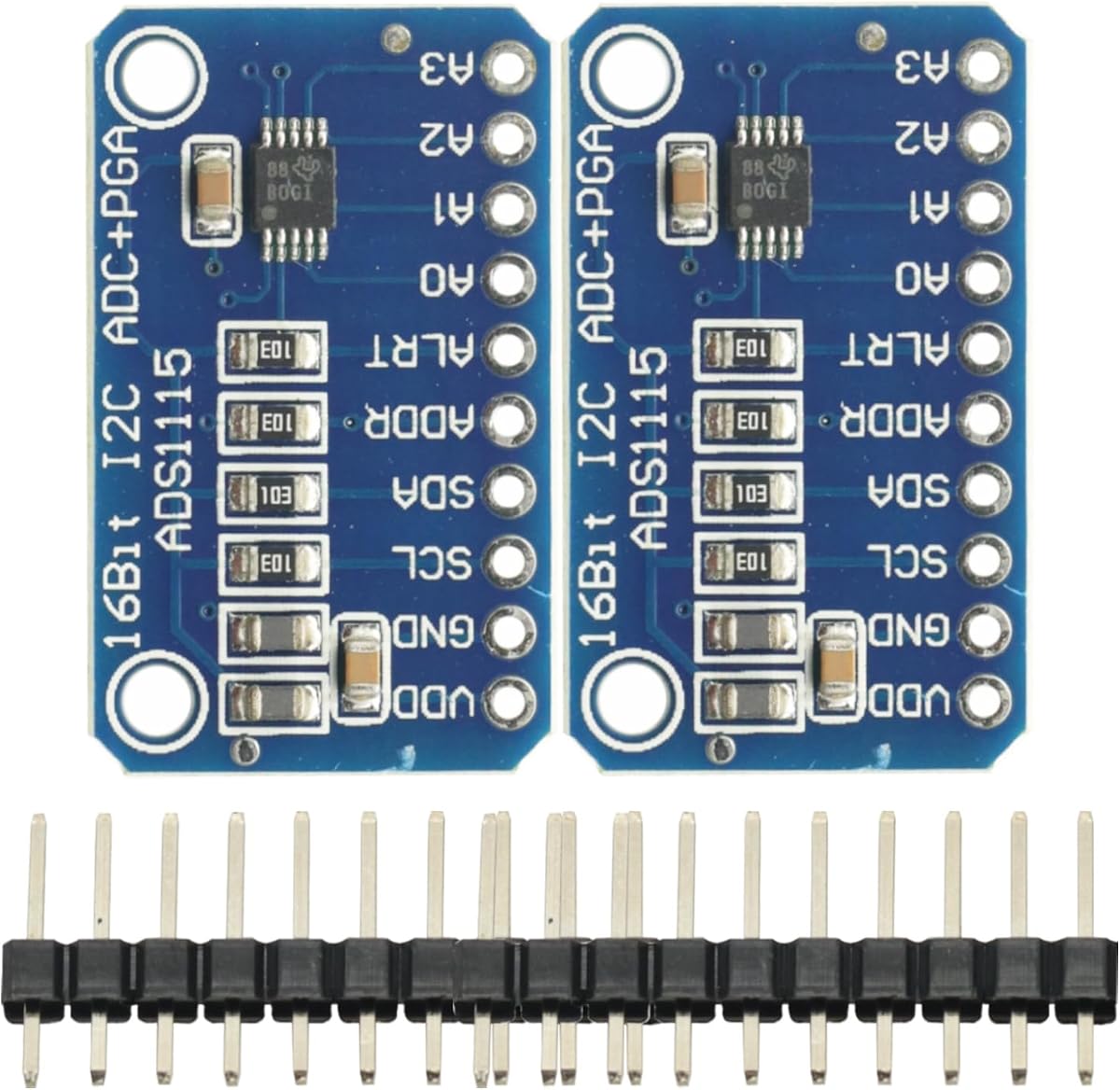
2Pcs ADS1115 16 Bit I2C Module Precision ADC 4 Channel Analog-to-Digital Converter Development Board Pro Gain Amplifier for Arduino Raspberry Pi ADC Module
5.0Editor score
2 Pack Value
I2C Interface
Low Voltage Range
This guide compares the top 10 Arduino ADC boards for precision sensing, data acquisition, and sensor interfacing to help you choose the right module for your
Choosing the right analog-to-digital converter is crucial for accurate sensor readings in your microcontroller projects. This guide reviews the top ADC boards compatible with Arduino and other platforms for 2026.
We evaluated each board based on resolution, channel count, communication interface, and ease of use. Our goal is to help you find the perfect module for your specific sensing and data logging needs.
Each pick highlights key features, pros, and cons to aid your decision. Note that pricing and availability may change over time, so verify details before purchasing your next development board.
5.0Editor score

4.7Editor score

4.4Editor score
The following table provides a side-by-side comparison of all ten featured products. It highlights key specifications like resolution, input channels, and communication protocols to help you compare options quickly.




The Teyleten Robot ADS1115 pack stands out as a top choice for makers needing reliable analog conversion. With a 4.7 rating, users appreciate its precision and ease of integration into Arduino projects.
We may earn a commission when you buy through this link, at no additional cost to you.
Its 16-bit resolution and programmable gain amplifier allow for measuring small voltage changes effectively. The I2C interface simplifies wiring, requiring only two data lines alongside power and ground connections.
While it is not designed for high-speed sampling, it excels in sensor applications like temperature or pressure monitoring. Some users note the need for external pullup resistors on the I2C bus.
This board is ideal for students and hobbyists looking for a cost-effective and accurate way to read analog sensors without built-in ADC capabilities on their microcontroller.
The programmable gain amplifier allows you to detect microvolt-level changes, making it suitable for thermocouples and strain gauges.
Operating between 2.0V and 5.5V, this module works seamlessly with both 3.3V and 5V logic systems without extra level shifting.
We may earn a commission when you buy through this link, at no additional cost to you.
For projects demanding extreme precision, the HiLetgo ADS1256 offers a massive 24-bit resolution. It is highly rated for its ability to capture minute signal variations accurately.
We may earn a commission when you buy through this link, at no additional cost to you.
The board includes an onboard reference voltage source, ensuring consistent measurements across different power conditions. It supports both single-ended and differential inputs for flexible signal conditioning.
However, using SPI means more wiring compared to I2C, and the software library is slightly more involved. This is a trade-off for the superior data quality it provides.
Choose this board if you are working with precision instruments or scientific data logging where accuracy outweighs speed and simplicity requirements.
You can measure voltage differences between two points directly, which is essential for eliminating noise in industrial sensor environments.
The integrated 2.5V reference source removes the need for external precision components, simplifying your circuit design significantly.
We may earn a commission when you buy through this link, at no additional cost to you.
This two-pack of ADS1115 modules delivers exceptional value for anyone building multiple projects. It holds a perfect 5.0 rating from users who love the reliability and cost efficiency.
We may earn a commission when you buy through this link, at no additional cost to you.
Having two units allows you to keep one as a spare or expand your project to multiple boards on the same I2C bus. It is a smart buy for classrooms or labs.
The modules are straightforward to use, though you might need to solder headers yourself depending on your specific use case. This minor effort is well worth the savings.
It is an ideal starting point for beginners who want reliable performance without spending too much on development hardware for their first prototypes.
Buying a pack means you are prepared for multiple builds or replacements, ensuring your work never stops due to a faulty component.
You can easily connect multiple modules on one bus, allowing for up to 16 channels of analog input across your system.
We may earn a commission when you buy through this link, at no additional cost to you.
The HiLetgo 3-pack ADS1115 is perfect for scaling up your electronics workshops or classroom setups. It offers three identical boards for consistent performance across multiple projects.
We may earn a commission when you buy through this link, at no additional cost to you.
With programmable gain amplification, you can adjust sensitivity to fit your specific sensor requirements without extra hardware. It is versatile enough for many common data logging tasks.
While the total cost is higher than single units, the convenience of having three pre-matched modules saves time in the long run. Some users note slight variations between batches.
This option is best suited for educators or builders who need reliable, uniform components for a series of similar devices or experiments.
Providing three boards ensures every student group can have their own module, preventing bottlenecks during practical electronics lessons.
If your project grows to require more inputs, having extra units on hand allows you to expand your system quickly and efficiently.
We may earn a commission when you buy through this link, at no additional cost to you.
For large scale production or massive hobbyist needs, this four-pack offers the lowest cost per unit. It delivers reliable 16-bit conversion suitable for general purpose use.
We may earn a commission when you buy through this link, at no additional cost to you.
The ability to operate in comparator mode provides additional functionality for threshold detection without needing a microcontroller constantly polling data. This is useful for simple alarm systems.
Some users report quality variations in the batch, so it is wise to test them upon arrival. For bulk orders, this risk is often acceptable given the price savings.
Select this pack if you are building many identical devices and need to minimize material costs while maintaining decent performance standards.
The onboard comparator lets you set limits to trigger alerts when voltages cross thresholds, simplifying your code logic significantly.
With a wide voltage range and stable operation, this board can handle varied power environments typical in diverse industrial or hobby setups.
We may earn a commission when you buy through this link, at no additional cost to you.
This two-pack combines affordability with high performance, earning a perfect 5.0 rating for its consistent operation. It is a solid choice for intermediate hobbyists and students.
We may earn a commission when you buy through this link, at no additional cost to you.
The module features programmable gain amplification to help you measure small signals accurately. Its wide voltage range ensures compatibility with most common microcontrollers available today.
While it does not include headers and has minimal documentation, the layout is standard enough to follow existing online tutorials easily. These are minor details for experienced users.
It strikes a great balance between cost and quality, making it a reliable pick for those who want good results without spending excessively on premium brands.
Supporting voltages from 2.0V to 5.5V means you can use it with battery-powered projects or standard 5V Arduino boards without issues.
The programmable gain feature allows you to zoom in on small signal ranges, improving accuracy for low voltage sensors like thermistors.
We may earn a commission when you buy through this link, at no additional cost to you.
The Lonely Binary 3-pack stands out for its gold plating and high-quality construction. This ensures better solderability and oxidation resistance over time compared to standard boards.
We may earn a commission when you buy through this link, at no additional cost to you.
Designed with open-source compatibility in mind, it supports a wide range of libraries for C++, Python, and CircuitPython. This makes it very developer-friendly and easy to integrate.
While it comes at a premium price, the durability and support justify the cost for serious projects. The pre-soldered headers save time and prevent soldering mistakes.
Choose this premium option if you value long-term reliability and are willing to pay a bit more for excellent build quality and community support.
Gold plating ensures that headers can be soldered easily without oxidation, leading to stronger and more reliable electrical connections.
Comprehensive library support for multiple languages means you can adapt it to almost any software ecosystem you prefer using.
We may earn a commission when you buy through this link, at no additional cost to you.
The AD7606 module is designed for applications requiring high-speed simultaneous sampling across multiple channels. It offers 200KHz sampling rates that outperform standard 12-bit ADCs.
We may earn a commission when you buy through this link, at no additional cost to you.
With eight input channels and true differential capability, it is perfect for motor control or vibration analysis. However, users note a complex setup process due to timing requirements.
The lower rating suggests that successful use depends heavily on precise wiring and configuration. It is not the easiest board for beginners to get working quickly.
Use this board if you have advanced timing requirements and the expertise to manage SPI protocols and synchronization without significant help.
All channels are sampled at the exact same time, which is critical for comparing signals that change rapidly in relation to each other.
Built with protection against overvoltage, this module is robust enough to handle the noisy environments found in industrial machinery setups.
We may earn a commission when you buy through this link, at no additional cost to you.
These ADS1115 modules are well-suited for IoT nodes where low power and stable readings are priorities. They offer solid performance for battery-powered sensor devices.
We may earn a commission when you buy through this link, at no additional cost to you.
With a 4.6 rating, they provide consistent results for temperature, pressure, or light sensors. Their compact size helps keep your device design small and portable.
While they are not intended for high-speed data logging, they are efficient for periodic monitoring. Integration is straightforward with standard I2C libraries.
This is a strong choice for makers building remote monitoring stations that need to run efficiently on limited battery power over long periods.
The board operates efficiently, allowing battery-powered projects to last longer without frequent charging or battery replacements.
The small footprint allows you to fit multiple sensors into tight enclosures without crowding your main microcontroller board.
We may earn a commission when you buy through this link, at no additional cost to you.
HiLetgo is a trusted name in development boards, and this ADS1115 module lives up to that reputation. It offers solid basic features at an affordable price point for most users.
We may earn a commission when you buy through this link, at no additional cost to you.
Its compatibility with Raspberry Pi is particularly useful since Pi boards lack native analog pins. It provides a direct way to interface analog sensors without extra hardware.
The comparator mode is a handy feature for simple threshold detection tasks. While it lacks advanced features, it covers most standard conversion needs effectively.
This board is recommended for users who prioritize brand trust and straightforward functionality over specialized high-end features in their projects.
Since Raspberry Pi lacks analog inputs, this module provides a seamless way to connect sensors to Pi projects using I2C.
It offers all the core features you need for general data acquisition, making it a no-fuss option for standard hobbyist applications.
We may earn a commission when you buy through this link, at no additional cost to you.
Selecting the right ADC board depends on your specific project needs, such as resolution, speed, and channel count. This guide covers the key factors to consider before making a purchase.
Resolution determines how finely the ADC can divide the analog input voltage. Higher bit counts like 16 or 24 bits provide more detail and are essential for precision measurements.
For general use, 16 bits is usually sufficient, but scientific instruments may require 24 bits to detect microvolt-level changes in signals.
The number of channels dictates how many sensors you can connect simultaneously. Boards with four or eight channels allow for more complex monitoring setups.
Check if the board supports differential inputs to measure voltage differences, which helps reduce noise in industrial environments.
I2C is simpler and uses fewer pins, making it ideal for small projects. SPI offers faster data rates but requires more wiring and processing power.
Choose I2C for ease of use and SPI when you need high-speed sampling rates for dynamic signal monitoring.
A PGA allows you to amplify small signals before conversion, improving accuracy for low voltage sensors. This feature is vital for precise measurements.
If you work with thermocouples or strain gauges, ensure your chosen board includes a PGA to handle small signal variations effectively.
Ensure the ADC board operates within the same voltage range as your microcontroller. Most modern boards support both 3.3V and 5V logic levels.
Mismatched voltage levels can damage components, so verify that your board supports logic tolerance for your specific microcontroller platform.
Sampling speed affects how quickly the ADC can capture data changes. Faster rates are necessary for audio or rapid signal monitoring.
For environmental sensors where changes are slow, lower sampling rates are acceptable and help save power in battery operated projects.
Look for boards with good solder masks and plated holes. High quality PCBs ensure better longevity and reliability over time.
Gold plating or robust components reduce the risk of oxidation and improve performance in harsh environments.
Strong library support simplifies integration with Arduino and other platforms. Open source libraries allow for easier customization and debugging.
Check community forums for available drivers to ensure you can quickly implement the ADC without writing low-level code from scratch.
Connect the VCC and GND pins to your microcontroller's power supply and ground rail. Use the SDA and SCL pins for I2C data communication to ensure proper wiring.
Install the appropriate driver libraries for your ADC chip in your Arduino IDE or preferred coding environment. Configure the gain and sampling rate through code to match your sensor needs.
Store your ADC boards in a dry place to prevent corrosion on the pins. Handle them by the edges and avoid bending the components to ensure long term functionality.
A 24-bit ADC offers much higher resolution, allowing it to detect smaller changes in voltage than a 16-bit ADC. This makes 24-bit boards ideal for scientific applications while 16-bit is sufficient for general hobbyist projects.
Yes, you can connect multiple I2C ADC boards by setting different addresses on each module. This allows you to expand your input channels significantly without using many digital pins.
Unstable readings often stem from power supply noise or ground loops. Ensure you use a stable power source and connect all grounds properly to minimize interference.
Most factory calibrated ADCs do not need user calibration, but you can implement software calibration for higher precision. Check the datasheet for specific calibration procedures if needed.
Voltage sensors, thermocouples, load cells, and humidity sensors work well with these boards. Ensure the output voltage range matches the ADC input range to avoid clipping or errors.
Many development boards have internal pull-up resistors, but external ones may be needed for long wires or multiple devices. If signals are weak, add 4.7k resistors to SDA and SCL lines.
We reviewed ten top options ranging from budget packs to high precision models. The Teyleten ADS1115 offers the best balance of precision and ease of use for most makers.
Prioritize resolution and channel count based on your project complexity. If you need speed, look at high sampling boards, but for general sensors, standard 16-bit modules are perfect.
Always check current pricing and availability before purchasing as stock can vary by region. Select the board that best fits your budget and technical requirements for the best results.