
ESP8266 ESP-01S
4.4Editor score
4MB Flash Memory
Stronger Signal Strength
Compact Serial Transceiver
This guide compares the top ten Arduino WiFi Module options available in October 2026 to help you choose the right wireless connectivity solution for your next
Arduino WiFi modules are essential for connecting your microcontroller projects to the internet and enabling smart home automation or remote sensor networks. Choosing the right board ensures reliable communication and efficient power management for your specific application needs.
We evaluated ten popular Arduino WiFi Module options based on performance, connectivity features, ease of use, and community support. Our analysis includes official boards from Arduino alongside trusted third-party ESP8266 and ESP32 variants for diverse budgets.
Each pick highlights unique strengths like dual-core processing, Bluetooth integration, or compact form factors. Note that product availability and pricing may change frequently, so verify current stock before making your final purchase decision.
4.4Editor score

4.7Editor score

4.7Editor score
This side-by-side comparison outlines the key specifications and capabilities of each Arduino WiFi Module to help you identify the best fit for your technical requirements.



The Arduino UNO R4 WiFi stands out as the top choice for modern IoT projects. It combines the reliability of a Renesas microcontroller with the powerful ESP32-S3 for dual wireless connectivity. Its 4.7-star rating reflects robust community approval and professional-grade features like CAN bus support.
We may earn a commission when you buy through this link, at no additional cost to you.
Its standout qualities include the integrated 12×8 LED matrix for instant visual feedback and the high-precision 12-bit DAC. The USB-C port ensures modern connectivity, while Qwiic connectors simplify sensor wiring. These features make it ideal for complex industrial or smart home applications.
Trade-offs include a higher cost compared to generic ESP modules and a larger physical footprint. However, the added features like CAN and OP-AMP provide value that justifies the investment for professional or advanced hobbyist projects.
This board is best suited for users needing advanced processing, reliable industrial communication, or integrated visual interfaces. If you prioritize long-term reliability and feature richness over raw budget, this is the premier Arduino WiFi Module available today.
The board supports both Wi-Fi and Bluetooth 5.0 alongside CAN for industrial-grade real-time communication.
Integrated OP-AMP and 12-bit DAC allow for high-quality analog signal generation without extra components.
We may earn a commission when you buy through this link, at no additional cost to you.
The HiLetgo 3pcs ESP8266 module offers an affordable entry point into wireless Arduino projects. It features the widely supported ESP8266 chip with LWIP stack compatibility. Its rating of 4.2 indicates reliable performance for basic IoT tasks.
We may earn a commission when you buy through this link, at no additional cost to you.
The main benefit is the 3-pack, allowing you to test multiple devices or keep spares. It supports AP and STA modes for flexible networking. The module is lightweight and ideal for battery-powered sensors where low cost is key.
However, it requires careful attention to voltage since it only supports 3.3V. Direct connection to 5V Arduino pins needs a level shifter. This can complicate wiring for beginners unfamiliar with voltage constraints.
Choose this if you need a budget-friendly Wi-Fi option for simple telemetry or smart home switches. It is perfect for developers comfortable with basic electronics who value quantity over advanced features.
Supports AP, STA, and combined modes for versatile connection options in various network topologies.
Built-in LWIP stack ensures efficient TCP/IP implementation for stable internet communication.
We may earn a commission when you buy through this link, at no additional cost to you.
The ESP8266 ESP-01S improves on earlier designs with 4MB flash memory and a stronger signal. It rates well at 4.4 stars due to its reliability and modern firmware support. This module is a staple for budget-conscious makers building simple network sensors.
We may earn a commission when you buy through this link, at no additional cost to you.
Its key strengths include ample storage for sketches and OTA updates. The latest version ensures better performance with minimal heat. It works easily with Arduino IDE when selected as a generic module, simplifying programming for most users.
Downsides involve its small form factor which can make soldering and breadboard use tricky. You may need a breakout board for comfortable use. Also, ensure your power supply is stable to avoid resets.
Pick this for simple telemetry projects where cost and size matter most. It is ideal for hobbyists who want a reliable Wi-Fi chip without paying for premium features like Bluetooth or extra processing power.
The 4MB flash memory allows for larger code libraries and persistent data storage compared to older versions.
Latest hardware revisions provide stronger signal strength for better connectivity in challenging environments.
We may earn a commission when you buy through this link, at no additional cost to you.
The Aitrip 5-pack provides a convenient supply for prototyping multiple devices. With 1MB SPI flash and standard ESP8266 performance, it covers basic Wi-Fi needs well. Its 4.4-star rating confirms consistent quality across units.
We may earn a commission when you buy through this link, at no additional cost to you.
The bulk nature allows for easy replacement or distribution across several projects. It supports AT commands for flexible serial communication. Compatibility with Arduino and NodeMCU makes it versatile for various environments.
The 1MB flash is smaller than the 4MB on the S version. This limits code size but is sufficient for simple tasks. Power sensitivity means a stable 3.3V source is required to avoid crashes.
Buy this if you need multiple units for a class project or home automation network. It is best for users who want a ready-made supply without worrying about individual component sourcing costs.
Easy AT+ command interface allows for simple configuration and testing using serial terminal tools.
Getting five modules in one package ensures you have spares for testing and deployment.
We may earn a commission when you buy through this link, at no additional cost to you.
The ELEGOO ESP-32 Dev Boards bring dual-core performance and Bluetooth 4.2 to your projects. With a 4.7 rating, these boards offer robust capabilities for complex IoT and automation tasks. The 3-pack adds value for multi-node networks.
We may earn a commission when you buy through this link, at no additional cost to you.
Its main advantages include high-speed processing for sensor fusion and OTA updates for remote maintenance. The USB-C port with CP2102 simplifies programming and power delivery. Bluetooth allows for mobile app control without extra modules.
The dual-core chip consumes more power than ESP8266. This makes it less ideal for battery-only devices unless deep sleep is used. The larger form factor might also be an issue for compact enclosures.
Choose this for advanced projects needing Bluetooth or heavy processing loads. It is perfect for smart home hubs, robotics, or projects where OTA updates are critical for long-term management.
Over-the-Air update support allows you to patch firmware on deployed devices without physical access.
Up to 240 MHz dual-core processing handles complex sensor data and logic simultaneously.
We may earn a commission when you buy through this link, at no additional cost to you.
The Arduino Nano ESP32 brings official Arduino support with modern ESP32-S3 features. It rates highly at 4.5 stars for its compatibility with MicroPython and HID profiles. It is designed for flexible IoT and embedded applications.
We may earn a commission when you buy through this link, at no additional cost to you.
Its main strengths include Python programming support and HID capabilities for custom keyboards or mice. The USB-C port ensures modern connectivity. Bluetooth 5.0 provides reliable wireless links for sensors and wearables.
The version without headers requires soldering or header kits for use. This may be a hurdle for quick prototyping compared to pre-assembled boards. However, it saves space and cost for production builds.
Select this if you prefer Python for coding or need specific HID features. It is best for developers seeking official Arduino ecosystem support with advanced Bluetooth capabilities and scripting language flexibility.
MicroPython compatibility enables rapid prototyping and interactive coding directly on the device.
HID support allows the board to function as a mouse or keyboard for secure automation.
We may earn a commission when you buy through this link, at no additional cost to you.
This ESP8266 ESP-01S pack provides four modules for distributed sensor networks. Its 4.4 rating reflects solid performance in home automation and wearable electronics. The self-calibrated RF ensures consistent performance across all units.
We may earn a commission when you buy through this link, at no additional cost to you.
Key benefits include reuse capability and RF optimization. This makes it easy to deploy multiple nodes without frequent failures. The compact size fits well in tight enclosures for wearable or mobile sensors.
Like other ESP-01S modules, it requires a breakout board for breadboard use. Power stability is also critical. If you are building a single prototype, buying in bulk might be overkill unless planning many devices.
Choose this for multi-node deployments like environmental monitoring. It is ideal for projects needing reliable wireless links across multiple physical locations with consistent signal quality.
Self-calibrated RF technology minimizes variability between units for consistent network performance.
The small footprint allows fitting multiple nodes into tight spaces for dense sensor arrays.
We may earn a commission when you buy through this link, at no additional cost to you.
This pack offers five ESP8266 ESP-01S modules with 4MB flash for expanded storage. It rates at 4.5 stars for reliable IoT performance and easy setup. The high baud rate ensures quick data transfer rates.
We may earn a commission when you buy through this link, at no additional cost to you.
The main advantage is ample storage for complex code and OTA updates. Using DOUT protocol simplifies flashing. This ensures stable communication with host microcontrollers. The 5-pack is ideal for class kits or production runs.
Voltage sensitivity remains a consideration. Using 5V can damage the module. Ensure you have a 3.3V regulator if your power source is 5V. This adds a small step to wiring.
Select this for projects needing more flash space for data logging or OTA features. It is best for bulk prototyping where having spares is valuable to keep production moving smoothly.
A baud rate of 115200 supports efficient data transfer for real-time sensor monitoring.
DOUT protocol ensures compatibility with standard flash tools and Arduino IDE settings.
We may earn a commission when you buy through this link, at no additional cost to you.
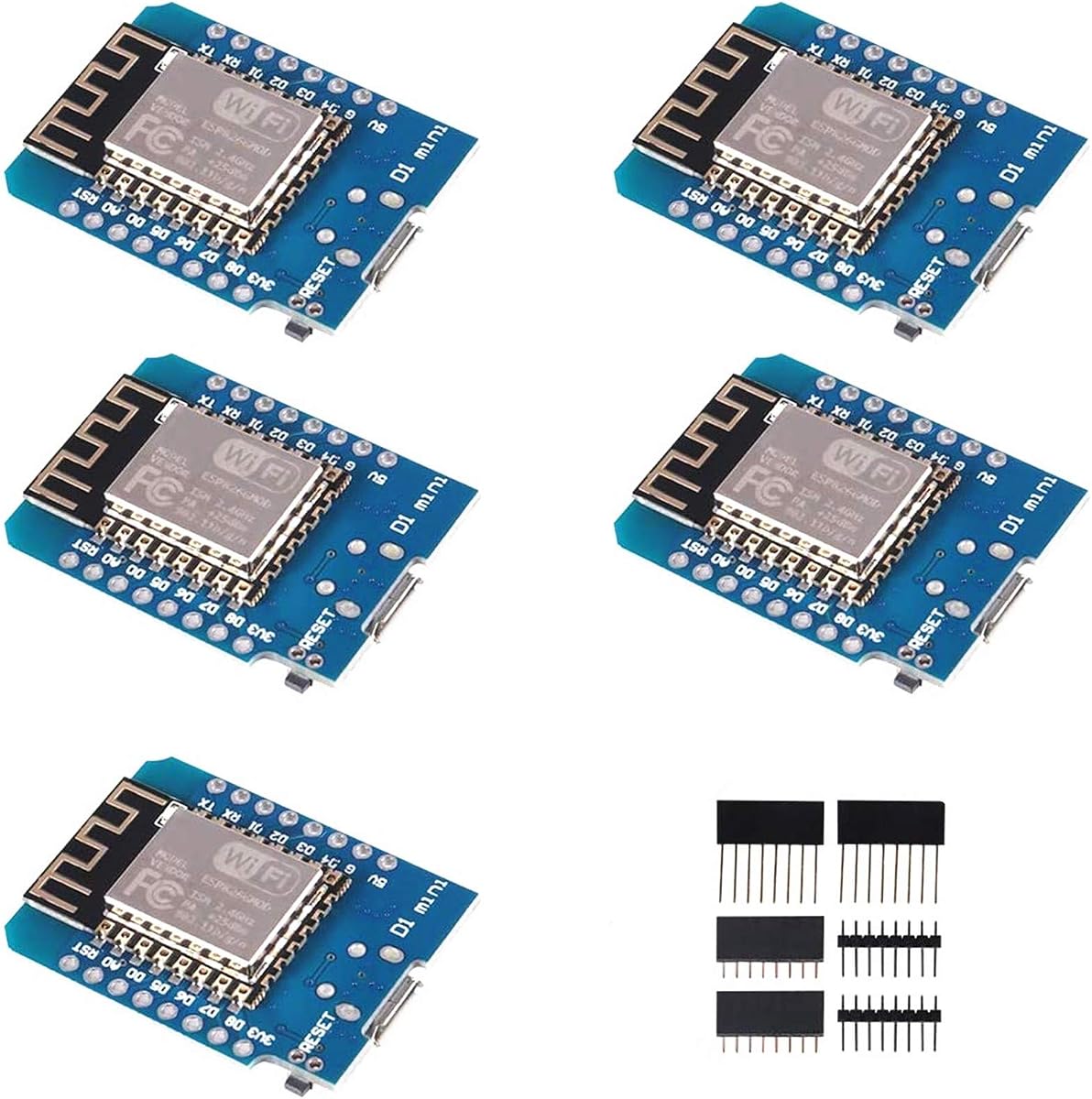
This set of five ESP-12F boards brings the classic NodeMcu Mini D1 design. With 4M flash and Micro USB support, it rates at 4.5 stars. It provides a convenient platform for Lua or Arduino development.
We may earn a commission when you buy through this link, at no additional cost to you.
The main benefit is the built-in 3.3V regulator and Micro USB connection. It simplifies power requirements compared to bare ESP chips. The 11 GPIO pins offer flexibility for connecting multiple sensors directly.
Micro USB is less durable than USB-C and requires specific cables. The soldering is typically required unless pre-soldered. Ensure you match power requirements to avoid overloading the onboard regulator.
Choose this if you prefer the classic NodeMcu layout for educational projects. It is ideal for home automation nodes where Micro USB power is convenient and standard GPIO access is required.
Onboard 5V to 3.3V switching regulator simplifies power delivery to external components.
11 digital I/O pins with PWM and interrupt support offer versatile hardware interfacing.
We may earn a commission when you buy through this link, at no additional cost to you.
The 10-pack of ESP8266 ESP-01 modules offers unmatched quantity for large-scale projects. With a perfect 5.0 rating, these modules are praised for reliability and robust processing. They are essential for bulk IoT deployments.
We may earn a commission when you buy through this link, at no additional cost to you.
Its strength lies in the sheer volume provided. You can outfit a whole building with sensors. LWIP support ensures smooth network communication. It is ideal for educational institutions or large product runs.
Each unit still needs proper voltage regulation and breakout boards for use. With 10 modules, power management becomes critical. Ensure your setup can handle multiple units if running simultaneously.
Select this for production runs or large-scale classroom projects. It is best for teams that need a large inventory of reliable Wi-Fi nodes without paying for individual units.
Ten modules allow you to scale your project across multiple rooms or devices easily.
Robust on-board processing ensures consistent task execution even under varying loads.
We may earn a commission when you buy through this link, at no additional cost to you.
Selecting the right Arduino WiFi Module depends on your project's power, processing, and connectivity needs.
Consider the microcontroller speed and core count. Dual-core options like ESP32 handle complex tasks better than single-core ESP8266.
Prioritize processors with enough RAM and clock speed for your specific application complexity.
Battery projects need low-power modes. ESP32 and ESP8266 offer deep sleep to conserve energy effectively.
Check active and sleep current values to ensure your power source can sustain the device.
Decide between Wi-Fi only or combined with Bluetooth. BLE supports low-power mobile interactions.
Ensure the module supports standard protocols you need like TCP IP or HTTP.
Flash memory size matters for storing code and OTA firmware updates. Look for 4MB or more.
Higher storage allows for more features and robust libraries without compilation errors.
Modules usually run at 3.3V. Verify your Arduino board compatibility to avoid voltage mismatch damage.
Use level shifters if your main board is 5V to protect your wireless module safely.
Boards with USB-C or built-in regulators simplify development. Bare modules require external breakout boards.
Choose integrated boards for rapid prototyping and bare modules for compact custom enclosures.
Popular models have better libraries and documentation. Official Arduino boards ensure maximum compatibility.
Check online forums for common pitfalls and code examples before purchasing a niche model.
Enclosure size dictates the module's physical footprint. ESP-01S is small, while ESP32 is larger.
Balance size with antenna performance to ensure signal quality is not compromised.
Ensure your module connects to a stable 3.3V power source. Voltage instability can cause connection drops or permanent damage.
Install the appropriate board package in your IDE to enable correct compiler settings for the chip model.
Keep the antenna clear of metal surfaces and enclosures to maximize signal strength and connection reliability.
ESP32 offers dual-core processing and Bluetooth alongside Wi-Fi. ESP8266 is single-core and Wi-Fi only. ESP32 handles more complex tasks but consumes slightly more power.
Use a regulated 3.3V source. If using a 5V Arduino, use a voltage regulator. Do not connect directly to 5V pins as it may burn the module.
Yes, install the ESP8266 or ESP32 board package in your IDE settings. Then select the correct board from the Tools menu to compile and upload code.
Over-the-Air updates let you send new firmware to the module wirelessly. This is crucial for devices deployed in hard-to-reach places.
This usually indicates unstable voltage or insufficient current. Use a dedicated power source and check wiring connections for loose contacts.
Both are similar, but external antennas on some variants improve range. Generally, a clear line of sight provides better performance.
The Arduino UNO R4 WiFi offers the most integrated features, while ESP8266 variants provide budget-friendly Wi-Fi for simpler tasks.
Prioritize processing needs and power constraints to select the right balance for your project. Ensure voltage compatibility before connecting any modules.
Always check current prices and availability before purchasing since stock levels vary frequently for popular electronics components.