
M-AUDIO Keystation 88 MK3
4.5Editor score
Plug-n-play USB connectivity
Semi weighted velocity keys
Compact slimline design
This comprehensive guide compares the top 88 key weighted MIDI controllers for 2026, evaluating key action, features, and integration to help musicians choose
Choosing the right MIDI controller is crucial for any serious music producer or keyboardist looking to expand their studio setup. An 88 key weighted MIDI controller offers the full range of a traditional piano, providing an authentic playing experience that is essential for expressive performances and realistic virtual instrument triggering.
We have analyzed the latest models available on the market, focusing on key action quality, connectivity options, and software integration. Our comparison covers a wide range of options from budget-friendly semi-weighted boards to premium hammer-action keyboards designed for professional recording environments and live stage performances.
Each pick in this list highlights specific strengths and potential trade-offs to help you find the perfect match for your workflow. Please note that product availability and pricing can change frequently, so we recommend checking the current links for the most up-to-date information before making your purchase decision.
4.5Editor score

4.6Editor score

4.3Editor score
The following table provides a side-by-side comparison of all ten models evaluated in this guide. We have included key specifications and unique selling points to help you quickly identify which controller aligns best with your specific musical needs and studio requirements.



The Novation Launchkey 88 [MK3] stands out as a top contender for producers seeking deep integration with their digital audio workstation. With a rating of 4.6 stars, it is praised for its seamless control over major DAWs and its premium semi-weighted keybed that offers a comfortable playing experience.
We may earn a commission when you buy through this link, at no additional cost to you.
Its key strengths lie in its powerful arpeggiator and creative scale and chord modes which allow musicians to unlock new melodic ideas quickly. The 16 velocity-sensitive pads add versatility for beat production while the custom modes enable control over external synths and hardware.
While the semi-weighted keys may not satisfy pianists looking for a hammer-action feel, they are well-suited for electronic music production and general MIDI control. The trade-off is acceptable given the extensive feature set and the affordability compared to premium alternatives.
This controller is ideal for producers who prioritize workflow efficiency and software control. It is highly recommended for those working primarily within Ableton Live or other supported DAWs who need a reliable and feature-rich tool for music creation.
The controller offers immediate access to transport and mixing controls reducing the need for mouse interaction during recording sessions.
Built-in arpeggiator and chord modes help users generate complex musical ideas even with limited theoretical knowledge.
We may earn a commission when you buy through this link, at no additional cost to you.
The M-AUDIO Keystation 88 MK3 is an essential tool for musicians on a budget who need a reliable 88-key controller. With a strong rating of 4.5 stars, it is valued for its plug-n-play connectivity and immediate creative potential without the need for complex setup.
We may earn a commission when you buy through this link, at no additional cost to you.
Its immediate creativity features include volume faders and transport buttons that simplify control over virtual instruments. The slimline design ensures it fits comfortably on any desk while the included software package provides everything needed to start producing music right away.
The lack of advanced features like aftertouch or assignable knobs is a trade-off for its affordability and simplicity. However for these omissions are acceptable for beginners or those who need a straightforward controller for basic MIDI input and performance.
This keyboard is perfect for students and home studio producers looking for an entry-level solution. It is recommended for anyone who wants a no-fuss MIDI controller that works immediately with their computer and includes essential production software.
USB connectivity allows for instant connection to Mac or PC without requiring additional power or driver installation.
The package comes with MPC Beats and Ableton Live Lite giving users a complete starting point for music production.
We may earn a commission when you buy through this link, at no additional cost to you.
The Arturia KeyLab 88 mk3 delivers a premium experience with its fully weighted hammer-action keys and high-quality construction. Rated at 4.3 stars, it is designed for keyboardists who demand an authentic piano feel and advanced performance features for serious music creation.
We may earn a commission when you buy through this link, at no additional cost to you.
Its standout qualities include 12 pressure-sensitive performance pads and robust pedal inputs that enhance expressive control. The inclusion of a sheet music stand and USB-C power reflects a thoughtful design aimed at modern studio and stage environments.
While the premium price and large size may be barriers for some users, the build quality and key action justify the investment. These trade-offs are acceptable for professionals who need a durable and responsive controller for daily use.
This controller is ideal for pianists and producers seeking a high-end solution. It is recommended for those who prioritize key feel and build quality and are willing to invest in a top-tier instrument for their studio.
The fully weighted hammer-action keys provide a realistic playing experience similar to an acoustic piano.
Pressure-sensitive pads and multiple pedal inputs allow for dynamic control during live or recorded performances.
We may earn a commission when you buy through this link, at no additional cost to you.
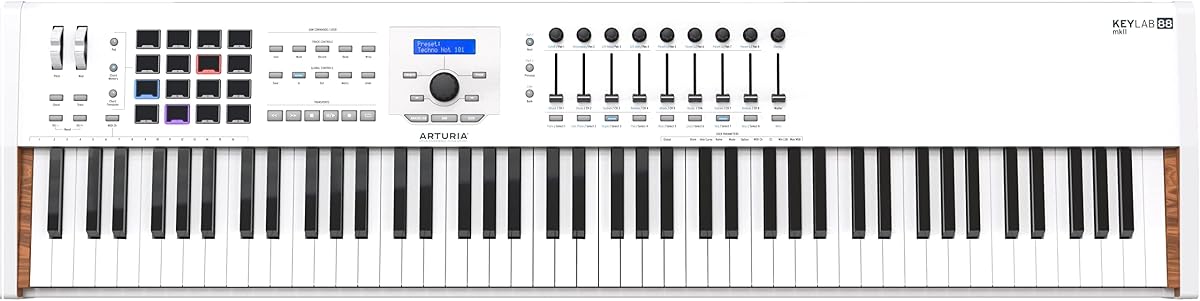
The Arturia KeyLab 88 mk3 in White offers the same premium features as the black model but with a distinctive aesthetic appeal. While it has a lower rating of 3.8 stars, it is valued by users who want a controller that matches a bright or modern studio setup.
We may earn a commission when you buy through this link, at no additional cost to you.
It shares the fully weighted hammer-action keys and 12 pressure-sensitive pads of its counterpart providing excellent performance capabilities. The white finish can make the unit stand out visually though it may show marks more easily than darker finishes.
The lower rating may reflect issues with the finish or specific quality control batches rather than functional performance. This trade-off is minor for those who prioritize aesthetics and are willing to maintain the unit carefully.
This controller is ideal for producers with a specific design aesthetic. It is recommended for users who want the premium features of the KeyLab series but prefer a lighter color for their studio environment.
The white finish offers a modern look that can complement bright or minimalist studio designs.
Despite the color difference, the controller offers the same technical specifications and performance capabilities.
We may earn a commission when you buy through this link, at no additional cost to you.
The Studiologic SL88 MK2 is designed for users who value robust build quality and extensive customization options. With a rating of 4.5 stars, it is praised for its weighted keys and the clarity of its onboard display which simplifies navigation and parameter changes.
We may earn a commission when you buy through this link, at no additional cost to you.
Its key strengths include seven encoders and the ability to store custom presets making it highly versatile for different setups. The compatibility with Numa Player software adds to its flexibility allowing users to tailor the controller to specific software needs.
The lack of a large number of pads and a steeper learning curve are trade-offs compared to more feature-rich models. However these are acceptable for keyboardists who prioritize key feel and control depth over pad functionality.
This controller is ideal for players who need a reliable and customizable tool. It is recommended for musicians who work with diverse software and require a durable interface for precise control over their virtual instruments.
Multiple encoders and an onboard display provide deep control over parameters without needing to look at a computer screen.
The chassis is built to withstand touring and heavy studio use ensuring long-term reliability.
We may earn a commission when you buy through this link, at no additional cost to you.
The YAMAHA P71 is primarily a digital piano but functions effectively as a MIDI controller for those prioritizing sound and key feel. With a high rating of 4.7 stars, it is loved for its acoustic piano-like touch and rich sound quality that enhances practice and performance.
We may earn a commission when you buy through this link, at no additional cost to you.
Its key strengths include the ability to layer sounds in Dual Mode and the inclusion of a sustain pedal and power supply. The streamlined functionality keeps users focused on playing without getting lost in complex menus or settings.
It lacks the deep MIDI controls and software integration found in dedicated controllers which limits its use for music production. This trade-off is acceptable for musicians who need a practice instrument that can also send MIDI data to a computer.
This keyboard is ideal for pianists who want a dedicated practice instrument. It is recommended for those who value sound quality and key action over advanced MIDI features and need a simple plug-and-play solution.
The weighted action keys replicate the resistance of an acoustic piano providing a realistic playing experience.
Dual Mode allows you to combine two voices for a richer and more complex sound.
We may earn a commission when you buy through this link, at no additional cost to you.
The Arturia KeyLab Essential mk3 offers a premium feel at an affordable price point making it excellent for beginners. With a rating of 4.4 stars, it is appreciated for its hybrid synth-piano keys and creative features like Scale and Chord Modes that simplify composition.
We may earn a commission when you buy through this link, at no additional cost to you.
Its standout qualities include the inclusion of Analog Lab Pro with 2000 presets and RGB-backlit pads for visual feedback. The custom DAW integration scripts allow for deeper control over popular software without needing complex setup.
The keys are hybrid synth-piano rather than fully weighted which may not suit classical pianists. This trade-off is acceptable for electronic producers and beginners who value versatility and features over a strict acoustic piano feel.
This controller is ideal for new producers and musicians. It is recommended for those who want a full-sized keyboard with modern features and software that helps them learn and create music effectively.
Scale and Chord Modes make it easier to play melodies and chords that sound good together.
The package includes Analog Lab Pro and subscriptions to Loopcloud giving a wide range of creative tools.
We may earn a commission when you buy through this link, at no additional cost to you.
The Arturia KeyLab 88 MkII is a proven controller that combines a high-quality Fatar keybed with extensive control options. Rated at 4.6 stars, it is valued for its aftertouch and velocity sensitivity which allow for expressive playing and detailed sound manipulation.
We may earn a commission when you buy through this link, at no additional cost to you.
Its key strengths include 16 RGB performance pads and a control bank with 9 faders and knobs for tactile mixing. The inclusion of Analog Lab V software provides a vast library of sounds ensuring users have everything they need to start creating.
As an older model, it lacks modern connections like USB-C and has a bulkier footprint than newer designs. This trade-off is acceptable for users who prioritize key quality and extensive controls over compact modern design.
This controller is ideal for producers who need expressive control and physical knobs. It is recommended for those who value the Fatar keybed and extensive control surface for managing complex projects.
Aftertouch and velocity sensitivity allow you to add emotion and dynamics to your performances.
Multiple faders and knobs give you hands-on control over mixing and sound parameters.
We may earn a commission when you buy through this link, at no additional cost to you.
The Roland A-88MKII is built to last with wood and premium materials that ensure dependable performance over years of use. With a rating of 3.8 stars, it is noted for its PHA-4 keyboard action which offers unmatched playability for professional keyboardists.
We may earn a commission when you buy through this link, at no additional cost to you.
Its standout qualities include MIDI 2.0 readiness and three customizable zones for dividing the keyboard. The thin design with shallow depth fits well in modern studio environments while the built-to-last construction protects it during transport.
The lower rating may reflect a higher price point for features that might not be necessary for all users. This trade-off is acceptable for professionals who prioritize durability and key action above other considerations.
This controller is ideal for touring musicians and professionals. It is recommended for those who need a reliable and durable instrument that can withstand the rigors of travel and frequent use.
Built with wood and high-quality materials to ensure longevity and resistance to wear.
MIDI 2.0 readiness ensures the controller will remain compatible with future software standards.
We may earn a commission when you buy through this link, at no additional cost to you.
The M-AUDIO Hammer 88 Pro offers a traditional piano feel with its graded hammer action keys and extensive control options. With a rating of 3.9 stars, it is designed for producers who need precise control over virtual instruments and Native Instruments software.
We may earn a commission when you buy through this link, at no additional cost to you.
Its key strengths include Native Kontrol Standard integration which allows direct control over NI presets and libraries. The inclusion of 16 RGB backlit drum pads and 9 assignable faders makes it versatile for both performance and mixing tasks.
The higher price and bulky design may not suit all budgets or small studios. This trade-off is acceptable for users who need the specific NKS integration and premium key feel for their workflow.
This controller is ideal for Native Instruments users and serious producers. It is recommended for those who prioritize hammer action and deep software integration for a professional studio environment.
NKS support allows you to browse and control sound libraries directly from the keyboard without computer interaction.
Multiple pads, faders, and knobs provide tactile control over a wide range of music parameters.
We may earn a commission when you buy through this link, at no additional cost to you.
Selecting the right MIDI controller involves considering several key factors to ensure it meets your musical needs and workflow. This section breaks down the essential aspects to evaluate before making a purchase.
Key action refers to how the keys feel when pressed and is critical for expressing dynamics. Weighted keys provide a resistance similar to an acoustic piano which is preferred for piano players and expressive performances.
If you play primarily piano, look for fully weighted hammer-action keys. For electronic production, semi-weighted or synth-action keys may offer faster response and easier playing.
Connectivity determines how your controller interfaces with your computer and other gear. USB is standard, but MIDI 5-pin outputs allow connection to hardware synthesizers without a computer.
Ensure your controller has the ports you need. USB-C is becoming standard for power and data, while MIDI Out ensures compatibility with legacy equipment.
Many controllers include custom scripts for specific Digital Audio Workstations (DAWs) that map controls automatically. This integration can save time and streamline your workflow.
Check if the controller supports your specific DAW. Deep integration with transport controls and mixer parameters enhances productivity.
Features like drum pads, faders, and knobs add versatility for beat production and mixing. Arpeggiators and chord modes help generate musical ideas quickly.
Consider how these features fit your workflow. If you produce beats, pads are essential. If you mix, faders and knobs are valuable.
A sturdy build ensures longevity and reliability especially if you plan to transport the controller. Materials like wood and metal contribute to durability.
Invest in a controller that feels solid. Check user reviews for long-term reliability reports.
The size and weight of the controller impact how easy it is to move. Slimline designs save desk space and make transport easier.
If you play live, consider a lighter model. For studio use, size matters less than features.
Prices vary widely based on features and build quality. Determine how much you can spend and prioritize features that matter most to you.
Higher price often means better key action and more controls, but budget options can be excellent for beginners.
Aftertouch allows you to modify sound after pressing a key, adding expression. It is a feature found in higher-end models.
If you need deep modulation capabilities, ensure the controller includes aftertouch. Otherwise, it may not be a priority.
To begin using your MIDI controller, connect it to your computer via USB and install any necessary drivers or software. Most modern controllers are plug-and-play, but checking the manufacturer's website ensures you have the latest updates.
Configure your Digital Audio Workstation to recognize the controller. Map the knobs and faders to specific parameters like volume or effects to maximize your control during production.
To care for your controller, keep it covered when not in use to prevent dust accumulation. Avoid extreme temperatures and humidity which can damage internal electronics and keys.
Semi-weighted keys have a spring-loaded mechanism that offers some resistance but is lighter than an acoustic piano. Fully weighted keys mimic the heavy action of a piano using hammers and are better for expressive playing. Choose based on your primary playing style.
Most modern MIDI controllers are class compliant and do not require drivers for basic functionality on Mac or PC. However, installing proprietary software can unlock advanced features and mappings.
Yes, many MIDI controllers can connect to tablets using an OTG adapter or camera adapter. Ensure your tablet supports MIDI input and you have a compatible DAW app installed.
MIDI pads are typically used for triggering samples, drum beats, or launching clips in your DAW. They offer a tactile way to create rhythms without using a keyboard.
Aftertouch allows you to modulate sound by pressing harder on a key after it has been struck. It is useful for adding expression to performances but is not essential for all producers.
Choose a digital piano if you prioritize sound quality and practice. Choose a MIDI controller if you need extensive control over software and integration with a DAW.
88-key controllers are wide and can take up significant desk space. Some models are designed to be slimline to reduce footprint, but they are generally larger than smaller keyboard controllers.
Yes, if your controller has MIDI Out ports, you can connect it to hardware synthesizers via MIDI cables. This allows you to play the synth using the controller keys.
We have reviewed ten top models ranging from budget-friendly options to premium instruments. The Novation Launchkey 88 [MK3] leads for integration, the M-AUDIO Keystation 88 MK3 for value, and the Arturia KeyLab 88 mk3 for premium features.
Prioritize the factors that matter most to your workflow. Whether it is key feel, software control, or build quality, choosing the right controller will significantly enhance your music production capabilities.
Remember to verify current pricing and availability before purchasing. Technology evolves quickly and new models may offer better value or features as you read this guide.